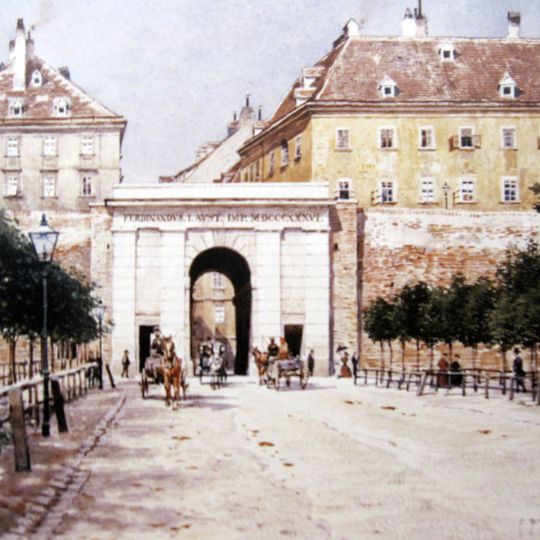
Stubentor, Former city gate site in Innere Stadt, Vienna, Austria
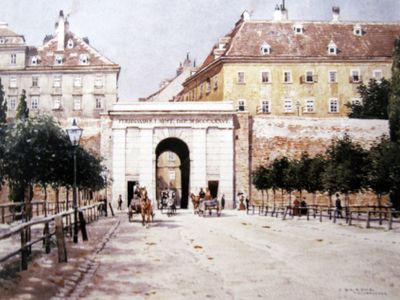
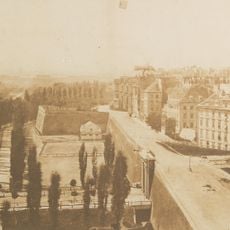
The Stubentor was a gate of Vienna's city wall, first built around 1200 with a forecourt and the Schwarzer Turm. Rebuilt in Renaissance style between 1555 and 1566 as a 25-metre-long box gate with a small bell tower, it was demolished in 1862. Today remains of the Renaissance wall and the gate's ground plan are visible near and inside the Stubentor U3 station.
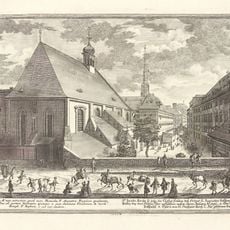
The oldest Stubentor, with a gate, an outer bailey and the "Black Tower", dates from around 1200 and formed part of Vienna's first city wall, built between 1195 and 1250. After the first Turkish siege of 1529 it was rebuilt in Renaissance style between 1555 and 1566 as a 25-metre-long box gate with a small bell tower; the wall withstood the second siege of 1683. In 1831 the gate received a classicist facade, and the wall up to today's Palais Coburg was demolished between 9 April and 19 September 1862.
The name Stubentor refers to a heated chamber (Stube), not to a nearby lane. In the 18th and 19th centuries funeral processions passed through the gate toward the Sankt Marx cemetery; mourners usually stopped at the city boundary. Mozart's body left Vienna here on 6 December 1791, and the cortege dissolved at the gate as usual.
The best way to view the gate is through glass panels in the floor near the entrance to Stubentor metro station. The location is easy to reach and sits within a straightforward part of the old city.
The medieval Black Tower and the ground plan of the 1555–1566 gate are traced in the street paving by the U3 station entrance, in black and in outline. The excavated remains of the Renaissance wall and a small exhibition on the gate can be seen in and in front of the station, built 1985–1987.
The community of curious travelers
AroundUs brings together thousands of curated places, local tips, and hidden gems, enriched daily by 93,892 contributors worldwide.