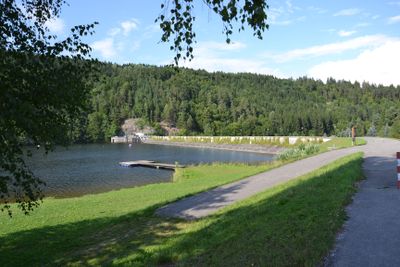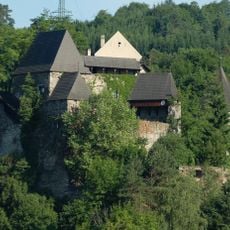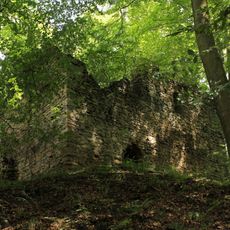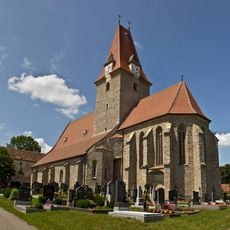
Thurnberger Stausee, Reservoir in the Waldviertel, Lower Austria, Austria
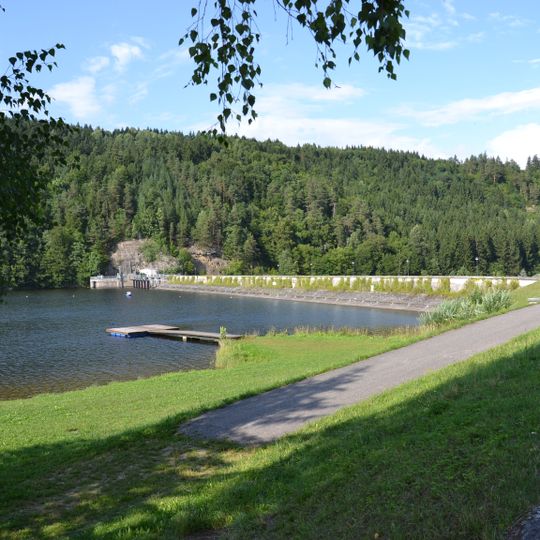
The Thurnberger Stausee is the third of the three Kamp valley reservoirs in the Waldviertel. Its barrier consists of a 20-metre-high, 51-metre-long concrete wall followed by a 200-metre-long earth dam 17 metres high. The reservoir holds about 2.5 million cubic metres of water, covers roughly 400,000 square metres and extends four kilometres upstream to Krumau am Kamp.
The reservoir was built between 1949 and 1952 primarily to provide reliable electricity and control river flow downstream. This infrastructure proved important for the local economy by making energy cheaper and more dependable for households and industries in the region.
The reservoir is named after Thurnberg, the village on its shore, and is the third of the three Kamptal reservoirs after Ottenstein and Dobra. Bundeskanzler Leopold Figl attended the opening on 9 July 1952 and gave a speech. A residential building for six families was erected beside the power plant for the operating staff.
The reservoir lies in the Waldviertel near Krumau am Kamp, and the water extends about four kilometres up the Kamp valley. The dam wall is 51 metres long and 20 metres high, followed by a 200-metre earth embankment 17 metres high. The 750-metre headrace tunnel through the hill is inspected for safety every three years.
The water does not flow from the reservoir through the tunnel; it is diverted from the reservoir through a 750-metre pressure tunnel under the mountain to the Wegscheid power station, where two Kaplan turbines generate 2.7 MW. The plant runs as a balancing facility for the lower Kamp and produces 70% of its annual output in winter.
The community of curious travelers
AroundUs brings together thousands of curated places, local tips, and hidden gems, enriched daily by 93,971 contributors worldwide.