Castra Namare, Unconfirmed Roman fort site in Melk, Austria
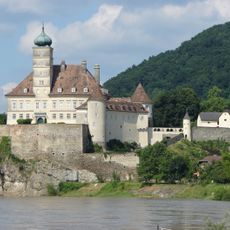
Castra Namare is a presumed Roman military camp whose existence has not been confirmed archaeologically. Since the 19th century, finds have suggested it lay beneath the present Melk Abbey, a complex built on a roughly 60-metre-high diorite ridge near the Danube. The site is largely overbuilt, so no fort has been excavated; the first documented church of Melk stood on the plateau of today's abbey park.
The site is a presumed Roman fort, never confirmed by excavation, since the whole area lies beneath Melk Abbey. The name Namare appears only on the 2nd-century Tabula Peutingeriana, listed seven Roman miles from Arelape (Pöchlarn) and 16 from Trigisamum. From the 18th century, chroniclers such as Johann Christoph von Jordan and Ignaz Franz Keiblinger placed Namare at Melk; in 2006 Roman finds at Großpriel raised doubts about that equation.
The name Namare appears only on the 2nd-century Tabula Peutingeriana, listed seven Roman miles from Arelape (Pöchlarn) and 16 from Trigisamum. Philologists argued over its origin: Alfred Holder thought Celtic, while Norbert Jokl, Erich Polaschek and Gerhard Rasch favoured Illyrian. The name Melk itself, per Walter Steinhauser, may come from Slavic Medjilica, "border river".
The remains are located at a site that is best reached by car or on foot, positioned near the modern town of Schönbühel-Aggsbach. It is helpful to take time exploring the area and appreciating its location along the river.
No Roman fort has ever been excavated at Melk: the site lies under the baroque abbey and its park, and the identification rests on chance finds and on the name "Namare" on the 2nd-century Tabula Peutingeriana, seven Roman miles from Arelape (Pöchlarn).
The community of curious travelers
AroundUs brings together thousands of curated places, local tips, and hidden gems, enriched daily by 93,609 contributors worldwide.