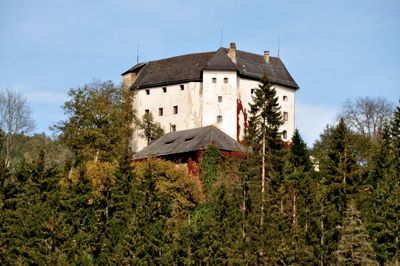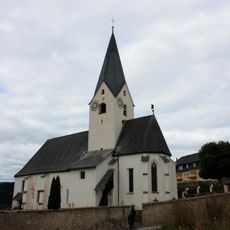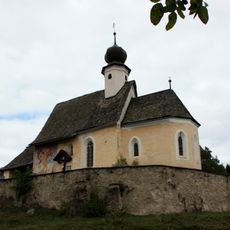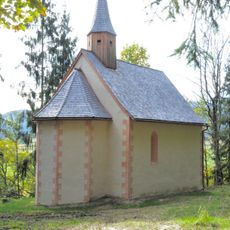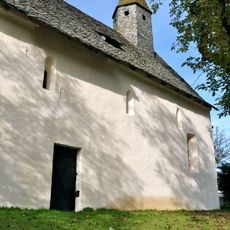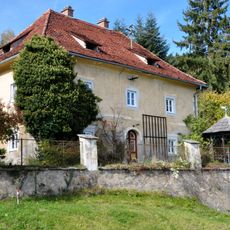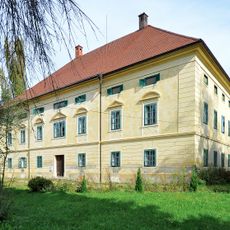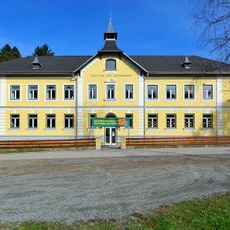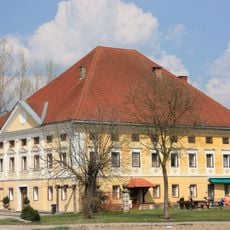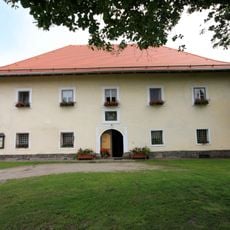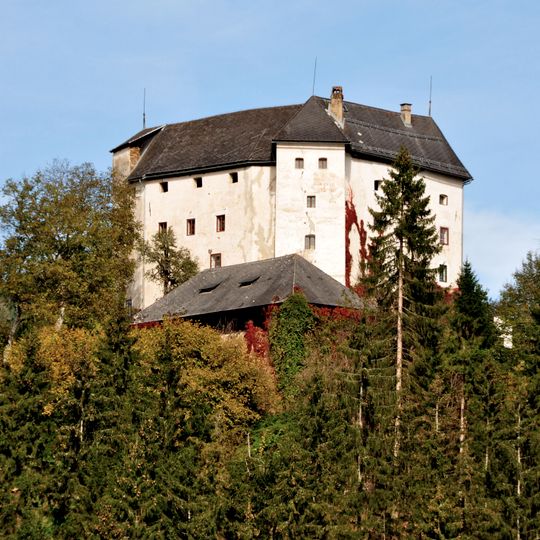
Schloss Rastenfeld, Heritage castle in Mölbling, Austria.
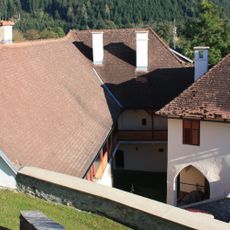
Schloss Rastenfeld is a massive four-storey late-medieval building on an irregular octagonal plan, with all wings built in the 15th century and renewed around 1500. A rectangular tower projects at the southwest corner, and two late-Gothic portals open into a narrow, irregular inner courtyard. The round-arched main gate, framed by large stone blocks with wheel deflectors, survives in its original form.
The Raspo family from Friesach built a castle here in the 13th century; a Raspo is documented in 1241, and the site appears as "Raspenveld" in 1432. Wilhelm von Perneck sold it in 1469 to Ulrich, Bishop of Gurk. Emperor Frederick III renounced his feudal lordship in 1478, and the diocese held it until 1530, converting the castle into a residence before selling it to Martin and Wolfgang von Feistritz.
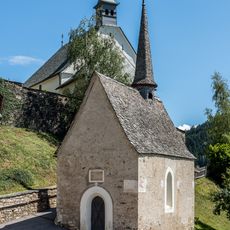
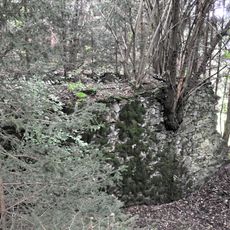
The chapel northeast of the castle, dedicated to Saint John Nepomuk in 1773, was built on the remains of a defensive tower; the former dungeon is still visible. Its apse has a painted baldachin and the tabernacle altar dates from 1774.
The castle sits on a spur of the forested Gunzenberg mountain, roughly 1.5 kilometers north of the village of Meiselding. Its location on an eastern-facing slope offers views and involves some climbing to reach.
The chapel northeast of the castle was built in 1773 on the remains of a defensive tower; the former dungeon is still visible inside. Its rococo tabernacle altar dates from 1774, and the roof turret carries an onion dome.
The community of curious travelers
AroundUs brings together thousands of curated places, local tips, and hidden gems, enriched daily by 94,041 contributors worldwide.