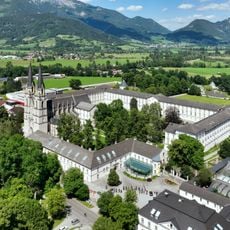
Riffel, Mountain summit in Steiermark, Austria
Riffel is a summit in the Ennstaler Alpen in Styria and rises to 2,106 meters above sea level. The peak sits within a mountain massif in central Austria, characterized by steep rocky faces and alpine meadows that surround the upper slopes.
The Riffel is built of Hauptdolomit, with Wettersteinkalk exposed on its north side. During the Würm glaciation the Enns glacier, 400 to 500 metres thick near Admont, shaped its northern foot; the end moraine is still visible through numerous erratic blocks. Alexander Bittner found fossils of the mussel genus Cardita and the sea urchin Cidaris dorsata on the south side of the Riffelschneide.
The Riffelgrat, the ridge linking the Kreuzkogel to the Riffel, is equipped as a secured via ferrata of difficulty A/B, and the Grüberach transition toward the Kalbling is a gentle grass slope. The Klinke-Hütte south of the mountain serves as the usual starting point, and the upper section below the Kalbling west wall demands sure footing and a head for heights.
The easiest ascent starts at the Klinke-Hütte and takes about 1¾ hours; the path below the Kalbling west face requires surefootedness and a head for heights. A harder approach comes from the west over the Kreuzkogel, reachable from the Klinkehütte, Kaiserau or Admont via a variant of the North Alpine Way (Austrian long-distance trail 01). The Kreuzkogel–Riffel ridge is a secured via ferrata of difficulty A/B, only for surefooted, vertigo-free hikers, and should be avoided when snow lies.
The Riffel's eastern side holds a grassy hollow that geologist Otto Ampferer described as a "sheltered enclosure" of old land surfaces spared by erosion, a Tertiary-era plateau cut into Hauptdolomit. On the southern edge of the Riffelschneide, Alexander Bittner found fossils of the mussel genus Cardita and the sea urchin Cidaris dorsata.
The community of curious travelers
AroundUs brings together thousands of curated places, local tips, and hidden gems, enriched daily by 93,687 contributors worldwide.