First Vienna Mountain Spring Pipeline, Water pipeline in Rax-Schneeberg region, Austria.
The First Vienna Mountain Spring Pipeline is a 95 km water conduit opened in 1873, carrying spring water by gravity from the Rax and Schneeberg areas in southern Lower Austria and Styria to Vienna. It still supplies about 62 million cubic metres a year, roughly 53 percent of the city's drinking water in 2007.
The pipeline was opened on 24 October 1873 after four years of construction, and was called the Kaiser-Franz-Josef-Hochquellenleitung in its day. It replaced house wells whose polluted groundwater had caused epidemics; earlier lines such as the Albertinische (1803–1804) and the Kaiser-Ferdinands-Wasserleitung (from 1836) no longer sufficed. The city council approved the project on 19 June 1866, and the geologist Eduard Suess wrote the 1864 commission report behind it.
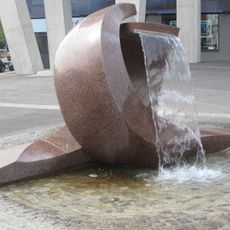
The name Kaiser-Franz-Josef-Hochquellenleitung honoured the emperor of the time; today the line is simply the I. Wiener Hochquellenleitung. Its water still reaches public taps and fountains across Vienna, and communities along the route hold water purchase contracts with the city.
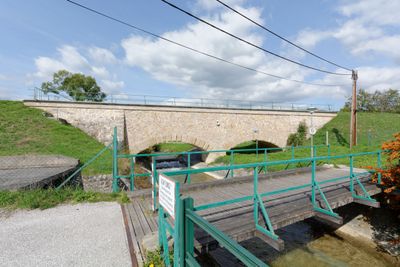
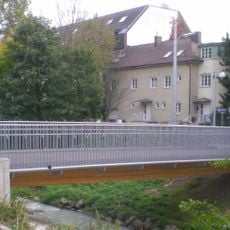
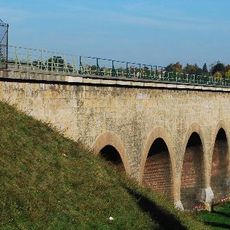
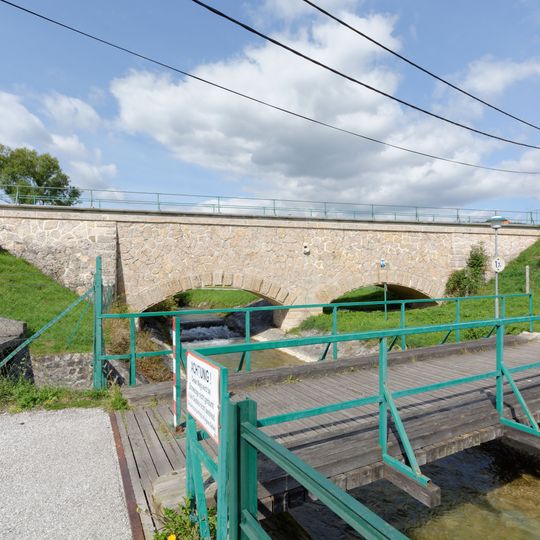
The line runs 95 km from the Rax and Schneeberg springs in southern Lower Austria and Styria to Vienna, working entirely by gravity, so no pump stations are needed. The photograph shows a pale stone bridge with two arches over a channelized stream, where wooden planks and green pipe railings cross beneath the arches; a white sign with a red border marked "ACHTUNG!" stands on the left railing. Several municipalities along the route hold water purchase contracts.
The route was chosen over a shorter option to the Fischa because no pump station was needed: the 1864 report by geologist Eduard Suess found the Kaiserbrunnen, Stixenstein and Alta springs would flow by gravity alone. The City Council ratified the proposal on 12 July 1864 by 94 votes to 2.
The community of curious travelers
AroundUs brings together thousands of curated places, local tips, and hidden gems, enriched daily by 93,898 contributors worldwide.