Josefsbrunnen, Protected water well in Innere Stadt, Austria.
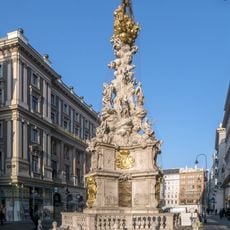
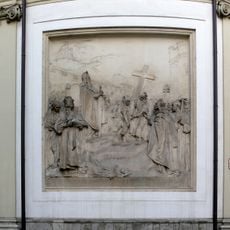
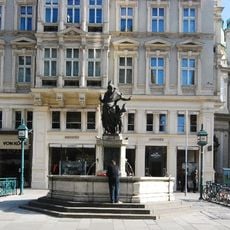
Josefsbrunnen is an octagonal stone basin on the west side of the Pestsäule on the Graben, with a classicist square pedestal at its centre. Two metal relief panels show the Flight into Egypt and the angel appearing to Joseph in a dream, and two lion heads spout water. On the pedestal stands a lead figure of Saint Joseph in antique robes with a staff, bending toward a boy holding a scroll.
A fountain stood on the Graben by the mid-15th century, fed by pipes from the Hofburg garden and called the Löwenbrunn for its four lion-head spouts. After the Plague Column rose in 1679, Emperor Leopold I ordered the two fountains flanking it rebuilt and dedicated to Saint Joseph and Saint Leopold; this was done in 1680–1681. Around 1730–1740 the fountains were substantially altered, and in 1804 Johann Frühwirth's saint sculptures were replaced by lead figures by Johann Martin Fischer.
The lead figure of Saint Joseph, leaning toward a boy holding a scroll of his lineage, replaced a stone sculpture by Johann Frühwirth in 1804, when Johann Martin Fischer's lead figures were installed. The octagonal basin carries two metal relief panels showing the Flight into Egypt and the angel appearing to Joseph in a dream.
The octagonal basin stands on the west side of the Pestsäule on the Graben, with the matching Leopoldsbrunnen on the east side. The fountain is in an open pedestrian street and can be viewed at any hour; the water flows from the two lion-head spouts on the east-west axis of the base.
Beneath the Josefsbrunnen lies Vienna's oldest underground public toilet, built in 1904/05. To make room for it, the fountain was dismantled and later put back in place. It was renovated again around 1987/88 together with the toilet below.
The community of curious travelers
AroundUs brings together thousands of curated places, local tips, and hidden gems, enriched daily by 93,912 contributors worldwide.