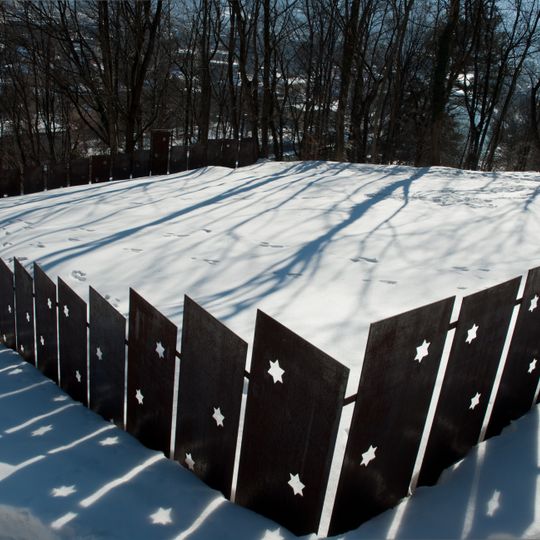
Judenbühel, Innsbruck, Jewish memorial and cemetery in Innsbruck, Austria.
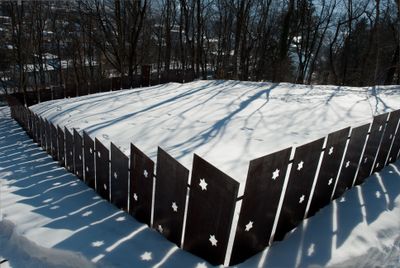
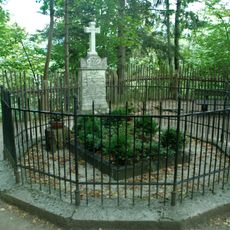
Judenbühel is a small hill on the slope of the Nordkette below the Hungerburg in Innsbruck's Mühlau district. It holds the site of Innsbruck's Jewish cemetery, used until 1864, now marked by a memorial. Reddish-brown steel plates bearing Stars of David trace the old cemetery wall on three sides, with a symbolic door at the former south entrance.
The cemetery operated from 1503 until 1864 and served as a burial ground for the local Jewish community. Vandalism incidents eventually led the community to relocate their graves to the Western Cemetery.
The name Judenbühel means "Jewish hill". The cemetery was first mentioned in 1503, and in 1598 Samuel May received permission to bury his descendants there, at "the Jews' old burial place". The dead were brought by wagon to the bathhouse in Mühlau and carried up a narrow field path. The memorial was blessed on 16 July 2009 by Chief Rabbi Paul Chaim Eisenberg.
The site is freely accessible and located in a quiet residential area that is easy to reach on foot. Archaeological work has revealed the original structure of the place, and the steel markers visible today help visitors understand the layout.
Archaeological investigation conducted in 2007 uncovered the exact structure of the forgotten cemetery, making it possible to create today's memorial. The steel plates were designed by artists Ada and Reinhard Rinderer to show where the original walls and entrances once stood.
The community of curious travelers
AroundUs brings together thousands of curated places, local tips, and hidden gems, enriched daily by 93,068 contributors worldwide.