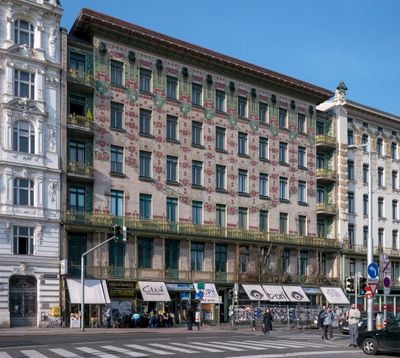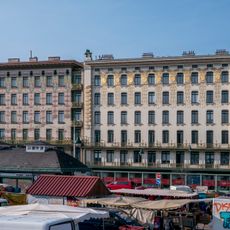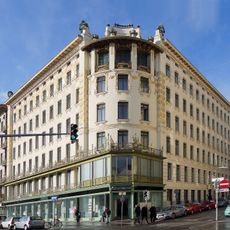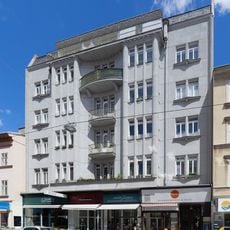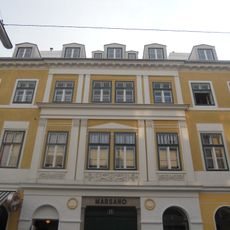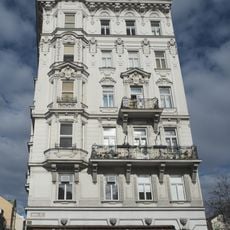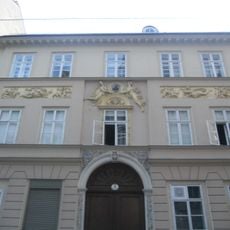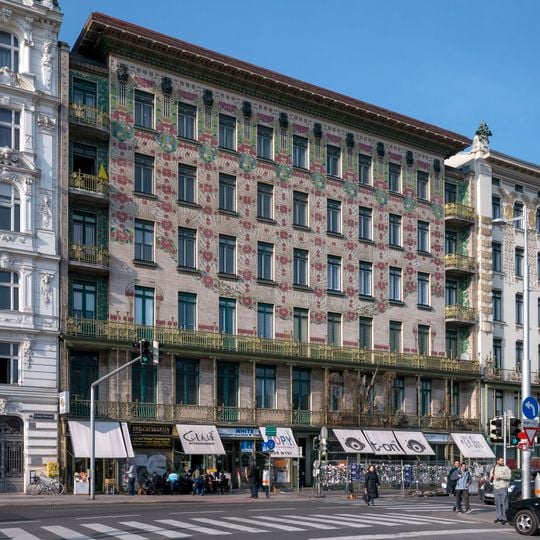
Majolikahaus, Art Nouveau residential building in Mariahilf, Vienna, Austria.
The Majolikahaus features decorative ceramic tiles covering its facade with floral patterns extending from the second floor to the top level.
Architect Otto Wagner constructed this residential building between 1898 and 1899 as part of the Vienna Lines houses series during the Secession movement.
The floral compositions on the majolica tiles, created by Alois Ludwig, reflect the artistic principles of the Vienna Secession movement in architecture.
The building contains fifty apartments distributed across five floors, with commercial establishments operating on the ground level at Linke Wienzeile 40.
Two long iron balconies span the entire length of the facade, complementing the green stems, tendrils, and lion head decorative elements.
Location: Mariahilf
Inception: 1898
Architects: Otto Wagner
Architectural style: Art Nouveau
Part of: Vienna Lines houses by Otto Wagner
Address: Linke Wienzeile 40
GPS coordinates: 48.19742,16.35925
Latest update: March 6, 2025 22:47
Art Nouveau emerged between 1890 and 1910 as one of Europe's most influential architectural and decorative movements. Architects of this period broke from historical precedents to develop a new visual language characterized by curved lines, plant motifs and richly ornamented facades. The movement took different names across countries: Modernisme in Catalonia, Jugendstil in German-speaking regions, Secession in Austria and Liberty in Italy. This diversity led to regional interpretations that incorporated local craft traditions and cultural characteristics. This collection includes buildings across Barcelona, Paris, Budapest, Vienna, Prague, Brussels and other European cities. In Barcelona, works by Antoni Gaudí and his contemporaries shape entire streetscapes, including Casa Batlló with its undulating facade and the Sant Pau Recinte Modernista. Paris preserves the celebrated metro stations by Hector Guimard, while Budapest features the Gresham Palace, Museum of Applied Arts and Gellért Baths. Vienna presents characteristic examples of the Austrian variant with the Secession Building and Majolica House. The collection also includes less visited sites such as the Kőrössy Villa in Kecskemét, Horta Museum in Brussels and the railway station in Helsingør, Denmark.
Between 1890 and 1910, Art Nouveau spread across Europe, producing buildings that combined craft traditions with industrial techniques through organic forms, natural motifs, and detailed ornamental work. Architects including Victor Horta in Brussels, Antoni Gaudí in Barcelona, and Otto Wagner in Vienna designed structures that departed from historical revival styles, instead emphasizing curved lines, wrought iron elements, and colored glass. The movement encompassed concert halls and railway stations as well as private homes and commercial facades, creating a body of work that remains central to the architectural identity of several European cities. Visitors can trace this development through multiple locations. Brussels offers the Victor Horta Museum, Tassel House, and Hôtel van Eetvelde as prime examples of the Belgian variant. Barcelona showcases Gaudí's Casa Batlló and Bellesguard alongside the Palau de la Musica Catalana with its elaborate tilework. Paris preserves Hector Guimard's Métropolitain entrances and the Lavirotte Building, while Prague presents the Municipal House and the Bedřich Smetana Museum. Nancy serves as a center of French Art Nouveau with the School Museum and Villa Majorelle, and Budapest displays the style through Gresham Palace and the Liszt Academy of Music. From Riga to Turin, Vienna to Belgrade, these buildings document a brief but influential period when architects reshaped urban environments across the continent.
Vienna Lines houses by Otto Wagner
9 m
3rd Man Museum
253 m
Heumühle
247 m
Linke Wienzeile 38
24 m
Amonstiege
251 m
Alfred-Grünwald-Park
206 m
Köstlergasse 3
58 m
Versicherung der österreichischen Eisenbahnen
104 m
Miethaus Stiegengasse 9, Wien-Mariahilf
135 m
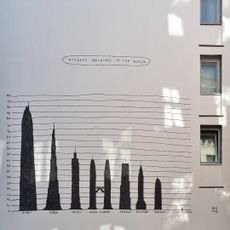
Buildings on Buildings No.2, Aldo Giannotti, Bruno-Marek-Hof, Vienna
208 m
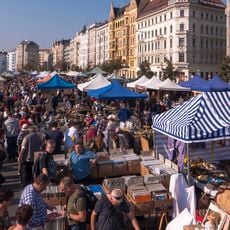
Flohmarkt beim Naschmarkt
68 m
Miethaus
207 m
Laimgrubengasse 22
236 m
Miethaus
211 m
Miethaus
229 m
Kettenbrückengasse 20, Vienna
161 m
Miethaus
251 m
Wohn- und Geschäftshaus
185 m
Ehem. Stadtbahn - Teilbereich der heutigen U4 in der KG Wieden
121 m
Ehem. Stadtbahn - Teilbereich der heutigen U4 in der KG Margarethen
179 m
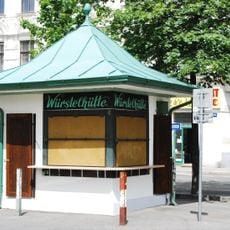
Würstelhütte, Linke Wienzeile
140 m
Malva-Schalek-Hof
230 m
Miethaus Linke Wienzeile 34
128 m
Gemeindebau Fillgradergasse 17-21
245 m
Laimgrubengasse 4, Vienna
123 m
Wohnhaus
113 m
Joanelligasse 5
167 m
Wohnhausanlage Rechte Wienzeile 25-27
234 mReviews
Visited this place? Tap the stars to rate it and share your experience / photos with the community! Try now! You can cancel it anytime.
Discover hidden gems everywhere you go!
From secret cafés to breathtaking viewpoints, skip the crowded tourist spots and find places that match your style. Our app makes it easy with voice search, smart filtering, route optimization, and insider tips from travelers worldwide. Download now for the complete mobile experience.
A unique approach to discovering new places❞
— Le Figaro
All the places worth exploring❞
— France Info
A tailor-made excursion in just a few clicks❞
— 20 Minutes