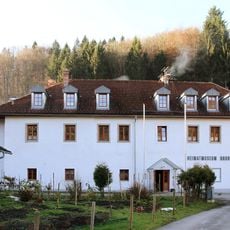
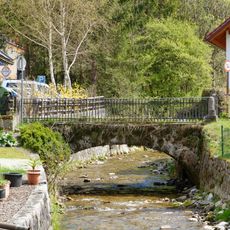
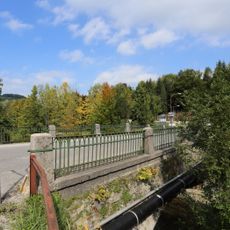
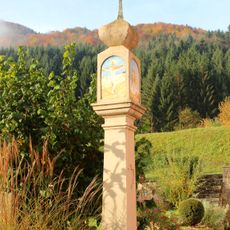
Schloss Neubruck und ehemaliges Töpperwerk, Castle and former ironworks in Neubruck, Scheibbs, Austria
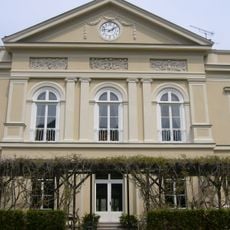
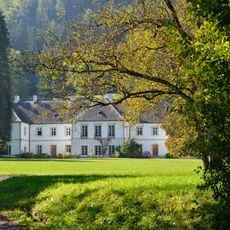
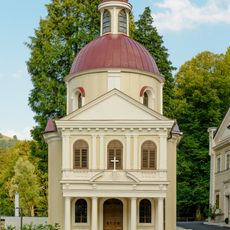
Schloss Neubruck is a four-winged historicist castle around a rectangular courtyard, built on the site of Andreas Töpper's Biedermeier manor house, whose core survives in the northwest wing. The north front has a neo-Renaissance facade with pilasters. The castle has fifty-two rooms, and the Andreaskapelle, a domed neo-Rococo chapel, stands opposite.
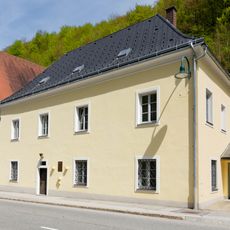
Andreas Töpper moved his operations from Styria to Neubruck around 1817 and built a sheet-metal rolling works on a disused hammer mill; by 1838 it was Austria's largest iron rolling works. Around 1825 he had the old hammer master's house enlarged in Biedermeier style, and between 1831 and 1834 the Andreaskapelle was added beside it. In 1881 Eduard Musil, Edler von Mollenbruck, bought the run-down works and had the manor rebuilt as a castle by 1885.
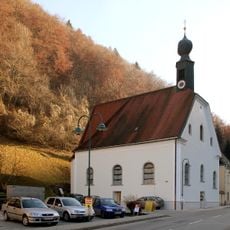
The chapel, built 1831–1834, was consecrated to Saint Andrew and Saint Helen, patron saints of Andreas Töpper and his wife; Archduke John attended the ceremony. Its dome fresco shows the Adoration of the Magi, and the 1834 organ was made by Joseph Gatto the Younger. The castle's dining room walls are covered with Delft pictorial tiles.
The castle now houses the Mostviertel Tourism office, where visitors can get information about regional attractions and cultural offerings. The grounds and building are most easily explored during the various events held throughout the year at the site.
The dining room walls are covered with large Delft pictorial tiles, and beside the fireplace stand two female mythological figures; the portrait above it is probably Eduard Musil von Mollenbruck. A painting of the castle's founder and his wife was used by Russian occupation troops as a target for shooting practice.
The community of curious travelers
AroundUs brings together thousands of curated places, local tips, and hidden gems, enriched daily by 94,598 contributors worldwide.