Wallfahrtskirche hl. Wolfgang, Catholic parish church in Kefermarkt, Austria
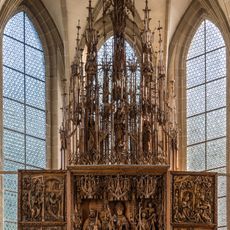
The Wallfahrtskirche hl. Wolfgang in Kefermarkt is a church building in late Gothic style with three aisles, ribbed vaults, and tall tracery windows that fill the interior with soft light. Its centerpiece is a carved wooden winged altar standing over 13 meters high, featuring intricate scenes from the life of Christ and depictions of saints including the patron saint Wolfgang in the center.
Christoph von Zelking had the church built as a pilgrimage site; the nave was erected from 1473 to 1476 and consecrated on 30 October 1476 by Passau auxiliary bishop Albert Schönhofer. The choir followed from 1490/1491 and was completed before 1500. The high altar was installed probably in 1497, after the founder's death. A parish was established on 14 September 1480 at Zelking's urging.
The church has served as a pilgrimage destination since the 15th century, drawing visitors who come to honor Saint Wolfgang. The altar and its decorations reveal how faith was expressed and how the community maintained this sacred space across generations.
The church is open daily from 9 in the morning until 6 in the evening, except during services, and welcomes visitors throughout the year. Guided tours are available in several languages and last about half an hour; individual visitors are encouraged to make voluntary donations, while groups pay a fixed fee.
On 4 November 1929 the church was sealed and filled with 75 kilograms of poison gas for eight days to kill woodworm threatening the altar and other furnishings. A hen placed inside walked out unharmed, and the all-clear was given, though the gas smell lingered for weeks.
The community of curious travelers
AroundUs brings together thousands of curated places, local tips, and hidden gems, enriched daily by 94,418 contributors worldwide.