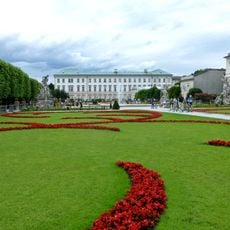
Zwergelgarten, Baroque garden in Salzburg, Austria
The Zwergelgarten is a group of dwarf figures carved from Untersberg marble after 1690, now standing on the Wasserbastei west of Mirabell Palace. A 15-step outdoor staircase flanked by two stone lions and a 28-metre wooden footbridge lead to the bastion garden. The figures were originally placed in the parterre of the Mirabell Garden, where a children's playground now stands.
The dwarf garden was laid out as part of Johann Bernhard Fischer von Erlach's plans for the Mirabell Garden, probably shortly after 1690; the first documentary evidence dates from after 1710. In 1811 the figures were auctioned off for small sums and scattered. On 20 October 1919 the city council resolved to rebuild the garden, and the dwarfs were provisionally placed on the Wasserbastei, where they remain.
The garden was originally called Pigatlgarten, later Pagodngarten. Its dwarfs, carved from Untersberg marble after 1690, were inspired by Jacques Callot's 24 caricatures of hunchbacks and paupers, published as "varie figure gobbi" and widely known across Europe. In Salzburg, court dwarf Josef Friedrich von Meichelböck (1687–1746) was a popular figure at the prince-bishop's court.
The dwarf sculptures are located within the larger Mirabell Garden and are accessible during garden hours. Plan your visit during warmer months when the entire garden is fully maintained and easier to explore.
The garden's first documented mention dates only from after 1710, yet no record of a redesign exists, so scholars place its creation in Fischer von Erlach's overall plan shortly after 1690. The dwarfs were auctioned off in 1811 and scattered; the city council voted to rebuild the garden on 20 October 1919.
The community of curious travelers
AroundUs brings together thousands of curated places, local tips, and hidden gems, enriched daily by 93,369 contributors worldwide.