Ter Doest Abbey, Benedictine abbey in Lissewege, Belgium
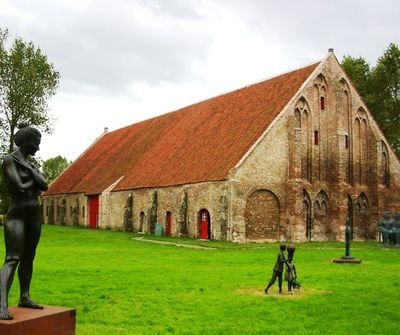
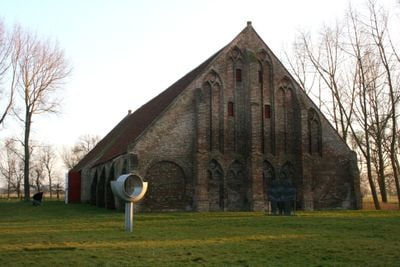
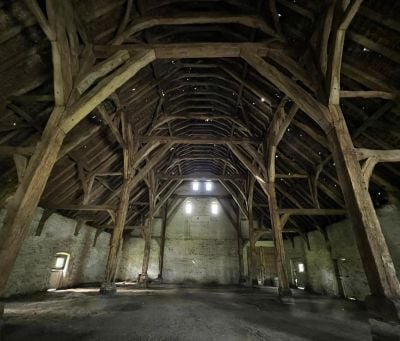
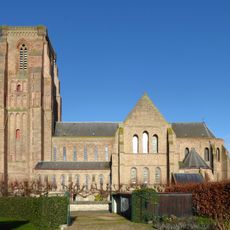
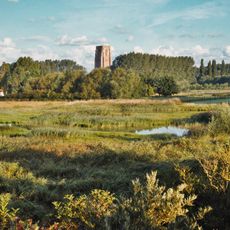
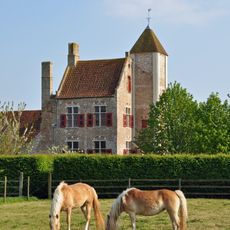
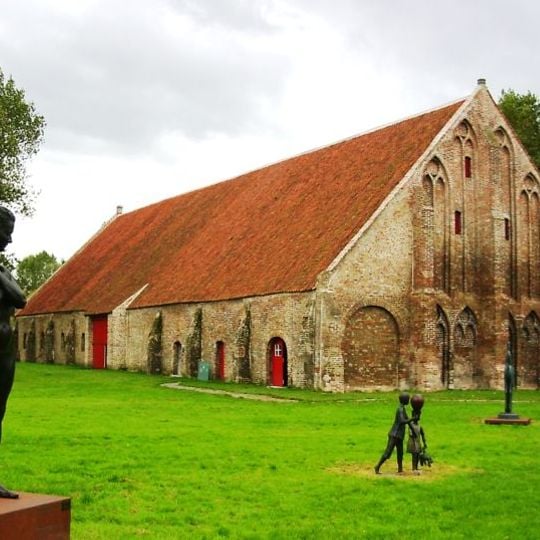
Ter Doest Abbey is a former Cistercian monastery in Lissewege, near Bruges. Its only surviving monastic building is the tithe barn, a brick structure 50.5 m long and 23.75 m wide, with a pointed gable rising 30.75 m and side walls 9.25 m high. Tall narrow pointed-arch panels and blind arches are set into the brickwork, and the roof, covered in 38,000 Boom tiles since 1711, ends in a slender chimney at the peak.
Lambert, lord of Lissewege, gave an estate with a chapel to the Benedictines in 1106, and they built the abbey. In 1175 it joined the Cistercian order as a daughter house of Ten Duinen Abbey in Koksijde, of the filiation of Clairvaux. It founded its own daughter house, Onze Lieve Vrouw Kamer, in 1223, and was dissolved in 1796 during the French Revolution.
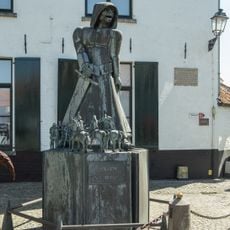
The abbey's monks were Cistercians from 1175, and their lay brothers helped build dykes and reclaim coastal land in Flanders, Zeeland and Holland. Ter Doest also took part in the wool trade with Flemish towns. A lay brother, Willem van Saeftinghe, fought at the Battle of the Golden Spurs in 1302.
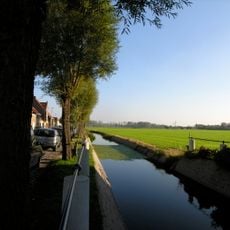
The site is located outside Bruges in a flat rural area best reached by bicycle or car. Wear comfortable shoes as you will walk between several buildings and outdoor spaces to see the full complex.
A bishop named Thorfinn from Norway found refuge here in 1285 after being forced out of his homeland. He spent his remaining years in the monastery, creating an unusual link between Scandinavia and this Flemish abbey.
The community of curious travelers
AroundUs brings together thousands of curated places, local tips, and hidden gems, enriched daily by 94,315 contributors worldwide.