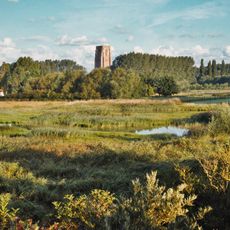
Onze-Lieve-Vrouw-Bezoekingskerk, Gothic parish church in Lissewege, Belgium.
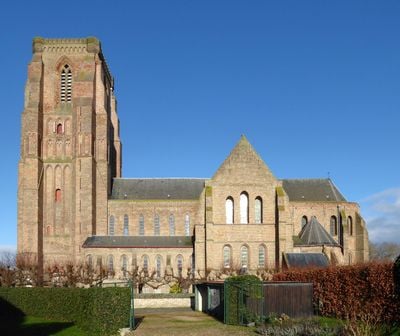
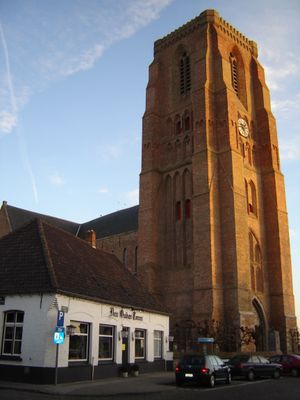
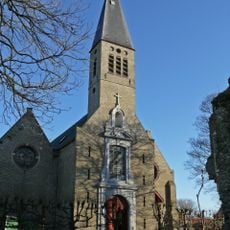
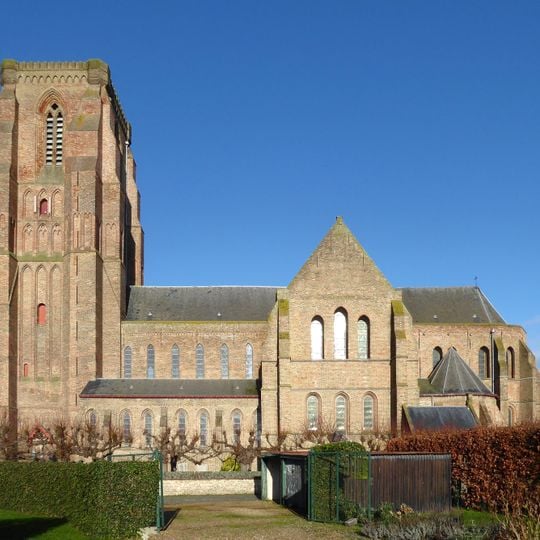
The Onze-Lieve-Vrouw-Bezoekingskerk is a three-aisled basilican cruciform church in Lissewege, built of local red brick with a heavy square west tower lacking a spire. The tower has angled buttresses, a stair turret in the south buttress, and a clock in a hexagonal frame on the west face. The choir and side choirs have seven-sided and three-sided east ends.
The present brick church was built in the mid-13th century in early Gothic style: choir, side choirs and transept in the second quarter, nave and west tower in the second half. In 1586 the church was set on fire and the miraculous Marian statue lost; the choir was repaired in 1613, the transept in 1617, and in 1624 a new statue came into use. Restorations followed from 1862 under Pierre Buyck and from 1890 to 1912 under August Van Assche.
The miraculous Marian statue carried in the annual Ommegang procession was lost when the church was burned in 1586; a new statue was put into use in 1624 and, like its predecessor, was carried annually by fishermen through Lissewege, Dudzele, Zuienkerke and Heist.
The building stands beside a cemetery enclosed by brick walls, with linden trees framing the access paths. Visitors should note that the pathways are well-maintained and lead to both the religious and historical sections.
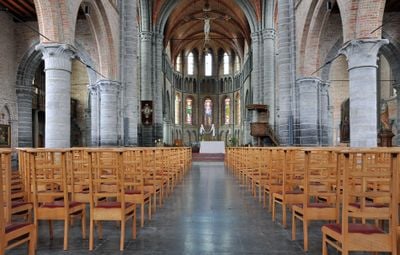
The nave and side aisles still carry the flat wooden ceilings installed in 1628, while the choir and transept were vaulted in brick between 1644 and 1650 by the Bruges master mason Gerard Coppet. Look up to compare the two roof systems in one building.
The community of curious travelers
AroundUs brings together thousands of curated places, local tips, and hidden gems, enriched daily by 94,349 contributors worldwide.