Abbey of Our Lady of Baudeloo, Cistercian monastery in Klein-Sinaai and Ghent, Belgium
Abbey of Our Lady of Baudeloo is a Cistercian monastery near Ghent with late Gothic structures and a neoclassical church portico. The complex includes several buildings with a notable Hemony carillon, which demonstrates traditional bell-casting craftsmanship.
The monastery was founded in 1215 but had to leave for Cologne in 1578 due to religious conflict. The monks returned later and rebuilt their community in Ghent, where it remained an active center of monastic life.
The name Boudelo combines Bouden, a pet form of Boudewijn (Baldwin), with lo, a small wood on sandy higher ground. The abbey's abbot held the privilege of administering the oath to the Count of Flanders as Lord of Waes. After the monks were expelled in 1578, the community briefly flourished again in Ghent.
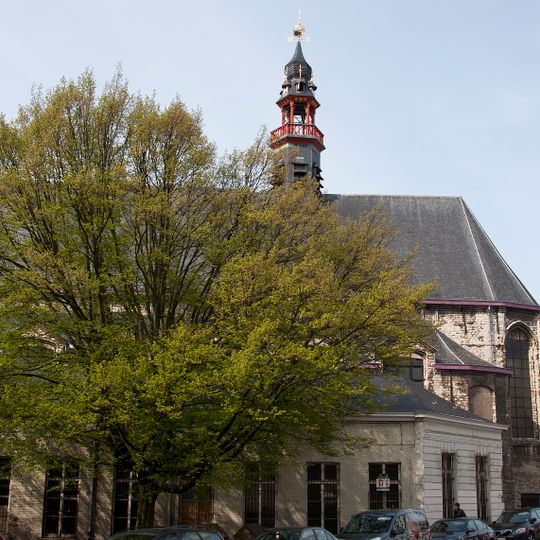
The former abbey site at Klein-Sinaai lies between the Koebrugstraat and Kloosterstraat; the Boudelohof of 1660 stands on the Koebrugstraat, and only its rear facade is visible from the street. The monastic buildings themselves were sold and partly demolished after 1578, so there is no roofed interior to visit. The community's later church in Ghent, finished by 1616, was used as a Temple of Reason and a theatre after 1797.
The abbey's abbot Theodorikus was murdered by members of his own community in 1226, and a violent quarrel in 1235 led to the abbey being placed under papal supervision. The Boudelohof at Koebrugstraat in Klein-Sinaai was built in 1660 from rubble of the demolished abbey; its rear facade is visible from the street.
The community of curious travelers
AroundUs brings together thousands of curated places, local tips, and hidden gems, enriched daily by 95,055 contributors worldwide.