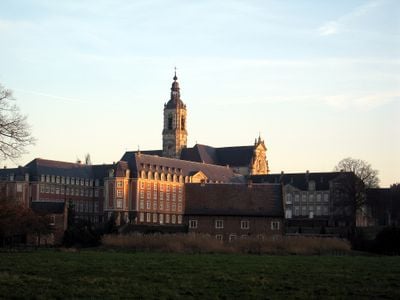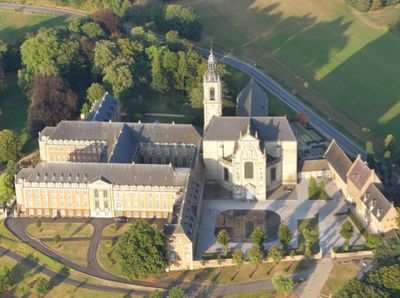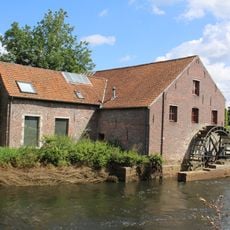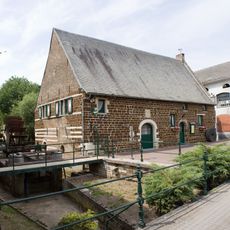
Averbode Abbey, Norbertine monastery in Scherpenheuvel-Zichem, Belgium.
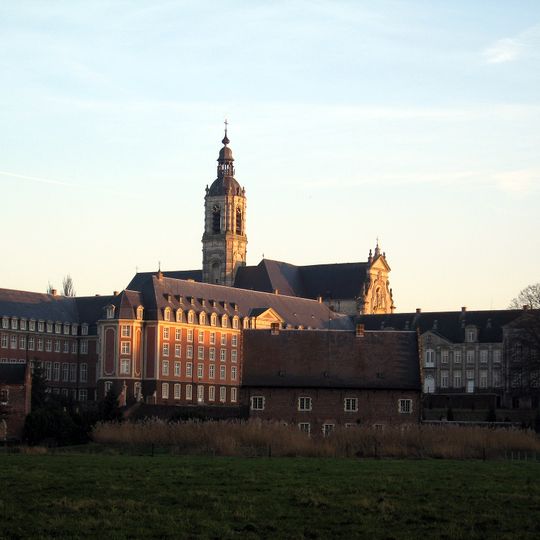
Averbode Abbey is a Premonstratensian monastery in Scherpenheuvel-Zichem, Flemish Brabant. Its church, built 1664–1672 to a design by Antwerp architect Jan Van den Eynde II, mixes Baroque and Gothic forms with Renaissance ornament and dominates the complex. The church and monastery were raised in iron sandstone from Langdorp and white sandstone from Gobertange; the gatehouse, from the end of the 14th century, is the oldest surviving building.
The monastery was founded in 1134 by Count Arnold II of Loon as a community where men and women lived together in religious practice. This dual structure was unusual for its time and shaped the abbey's early development.
The abbey's church, rebuilt between 1664 and 1672, holds an altar dedicated to Norbert, founder of the Premonstratensian order, listed among the Flemish Masters in Situ. In 1894 a new altar was placed in the church, dedicated to Our Lady of the Sacred Heart, followed in 1899 by a similar Sacred Heart altar. The Brotherhood of Our Lady of the Sacred Heart, founded in 1877, grew to 400,000 members by 1894 and gave rise to the abbey's printing and publishing work.
The oldest surviving structure is the gatehouse from the late 14th century, so look for it first when orienting yourself on the site. The abbey church, rebuilt between 1664 and 1672 to a design by Jan Van den Eynde II, stands at the centre of the complex. The grounds lie in Averbode, part of Scherpenheuvel-Zichem in Flemish Brabant.
The abbey's 1772 pipe organ by Guillaume Robustelly was sold to the Sint-Lambertuskerk in Helmond, Netherlands, after the French suppressed the abbey in 1796, and can still be heard there. The abbey church now holds three organs, including one built by Verschueren in 2001-2002.
The community of curious travelers
AroundUs brings together thousands of curated places, local tips, and hidden gems, enriched daily by 93,631 contributors worldwide.