Bouchout Castle, Medieval castle in Meise, Belgium
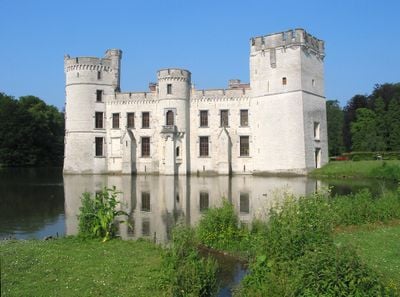
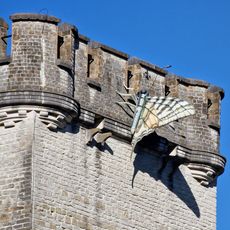
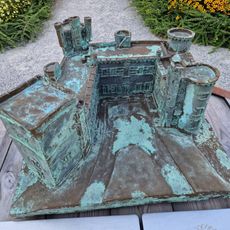
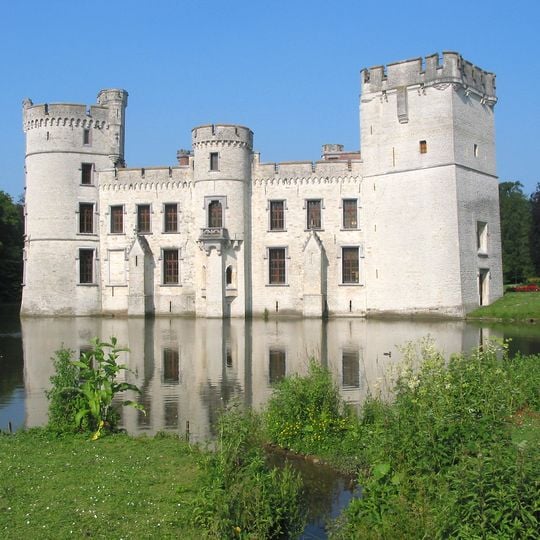
Bouchout Castle is a light-coloured stone castle standing directly in water in Meise. Its long central range is flanked by a round tower on the left and a tall square keep with a crenellated top and small corner turrets on the right; a semi-circular bay projects above the roofline in the middle. The keep, the oldest surviving part, has two levels with loopholes and a row of corbels below its roof.
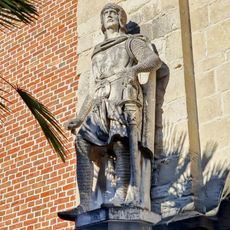
The first fortification at this site was built in 1150 by Wouter van Craaynem during the Grimbergen Wars in the Duchy of Brabant. The distinctive square medieval tower constructed by knight Daniel van Bouchout around 1300 remains the oldest surviving part of the structure.
The name Bouchout derives from "Boekhout", meaning beech, after the beech trees of the swampy domain; a rival reading of "boog-hout" (keep your bow tensed) is not substantiated. Empress Charlotte of Mexico lived at the domain from 1879 until 1927, after her husband Maximilian was executed in 1867. Since 1938 the domain has housed the botanic garden, now Meise Botanic Garden.
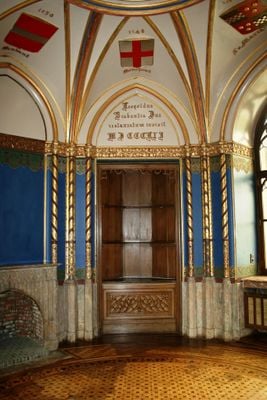
The castle stands on an island in the pond and is reached by a bridge; its rooms have served since the 1987–1989 renovation for meetings, lectures and exhibitions. The surrounding Meise Botanic Garden, developed from the Bouchout Domain since 1938, has paths through its collections. Check the garden's opening arrangements before setting out.
The foundation of the current complex is an armed tower structure built by Daniel van Bouchout in medieval times as a defensive response to local conflicts. This oldest structure was later expanded with additional defensive towers and remains recognizable today by its distinctive square shape.
The community of curious travelers
AroundUs brings together thousands of curated places, local tips, and hidden gems, enriched daily by 93,601 contributors worldwide.