Kattendijksluis, Lock in North Antwerp, Belgium
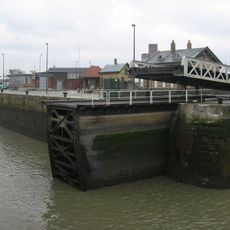
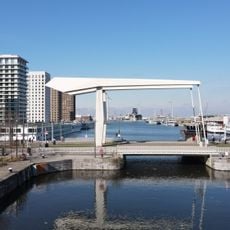
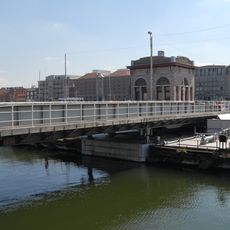
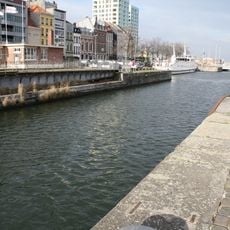
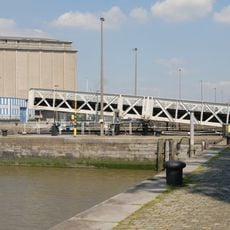
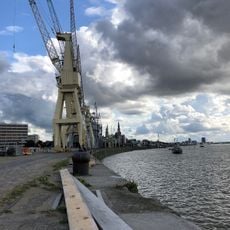
Kattendijksluis is a tide lock in North Antwerp, built in 1858–59 and the oldest surviving lock in the city. Its chamber is 120 metres long and 98 metres wide, with five flap doors (one ebb door and four flood doors). A white steel truss bridge with a zigzag lattice crosses the lock, and the concrete side walls carry blue metal mechanisms with long white beams.
Built in 1858–59 as a tide lock, the Kattendijksluis let sailing freighters and later motorised barges of up to 39 m by 5.10 m moor safely in the Kattendijkdok, opened in 1860. It was taken out of service around 1994–95 because tidal waiting times made it unprofitable. After works from February 2009 costing 17.5 million euros, it reopened on 25 September 2011.
The lock's name comes from the Kattendijk, the dike that once bordered this part of the port. Until the 1990s, lock keepers worked the five doors with capstans turned by hand, using chains. Since 2011 the lock has served only pleasure craft and passenger boats, which enter through the white truss bridge visible above the gates.
The lock only operates when the Scheldt level is between +2.2 m and +4.6 m TAW, roughly two hours before to two hours after high water in Antwerp, and it closes above +5.0 m TAW. Boats reach it on VHF channel 69, and only pleasure and passenger craft are admitted. The fixed Kattendijkbrug of 2005 crosses the chamber, so the gates and the white truss can be viewed from the public bank.
The lock's five doors once had to be cranked open and shut by hand, using capstans that pulled chains. Barges up to 39 m long and 5.10 m wide were the usual traffic. Since 2000 the inner doors stay open, so the lock now works as an open link to the Kattendijkdok rather than a true lock.
The community of curious travelers
AroundUs brings together thousands of curated places, local tips, and hidden gems, enriched daily by 93,940 contributors worldwide.