Jean-Félix Hap Garden, Protected heritage park in Etterbeek, Belgium.
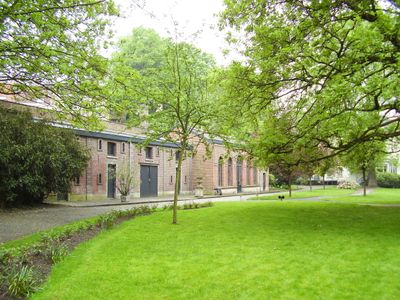
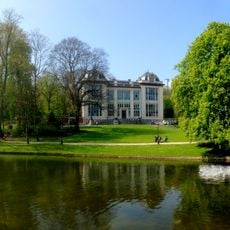
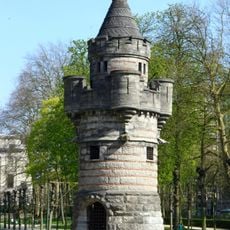
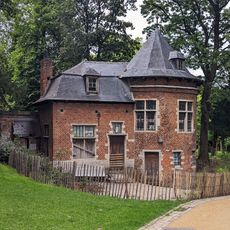
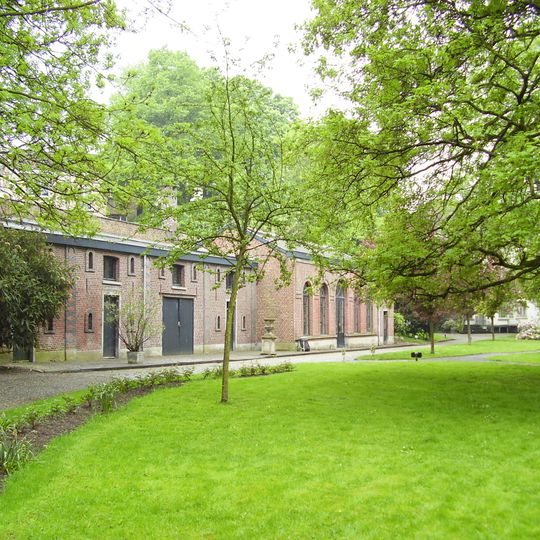
Jardin Jean-Félix Hap is a walled park of about 1.2 hectares in Etterbeek, entered through a small gate in the wall along the chaussée de Wavre. At its centre stand the remains of a 16th-century Flemish Renaissance castle, reduced to a ruin beside a natural pond fed by a spring of the Broebelaar. The former orangery of around 1850, later a stable and artists' workshop, and a small glazed kiosk stand in the grounds, whose lawn holds chestnuts, poplars, maples, catalpas and a Virginia tulip tree listed as a remarkable tree.
Albert Joseph Hap acquired the property in 1804, which included a 16th-century Flemish Renaissance castle and a pond fed by the Broebelaer stream. These two structures continue to define the character of the site today.
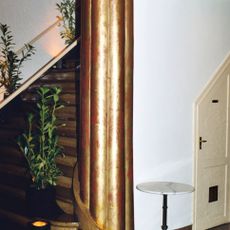
The murals by Edouard Navez (1840–1910) decorate the private quarters in the left wing of the neoclassical house at 508 chaussée de Wavre, not a dining room. They depict Etterbeek views such as the Sainte-Gertrude church and the mill of the Chasse royale, and survived the 1905 alterations by architect G. Thoelen.
The garden is hidden inside the block and reached through a small gate in the wall along the Chaussée de Wavre, with further entrances at Rue Louis Hap and Avenue d'Auderghem 191. The Dutch-language library of Etterbeek occupies one side of the park, its entrance on the Avenue d'Auderghem.
The 2004 extension along Avenue d'Auderghem is a semi-natural teaching area showing how urban gardens can host native flora and fauna: a dry zone and a wet zone, hedges and ground-cover plants, and piles of wood. It opened a second entrance to the garden.
The community of curious travelers
AroundUs brings together thousands of curated places, local tips, and hidden gems, enriched daily by 94,362 contributors worldwide.