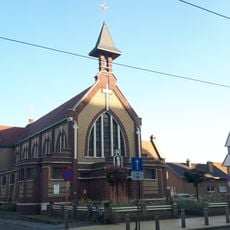
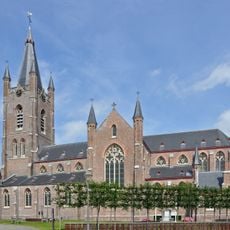
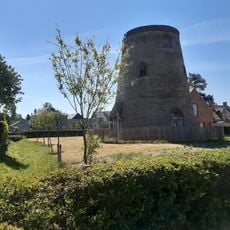
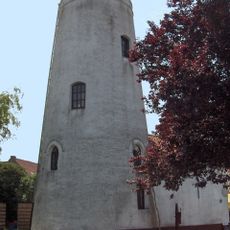
Walraversijde, Medieval village museum in Ostend, Belgium.
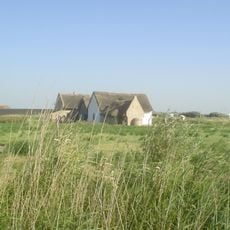
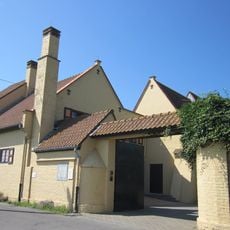
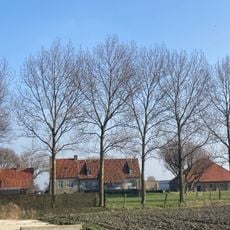
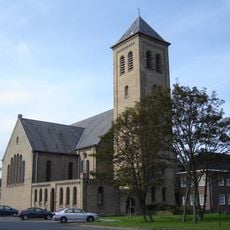
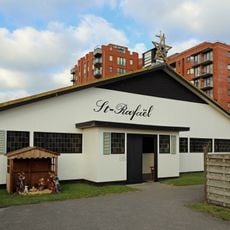
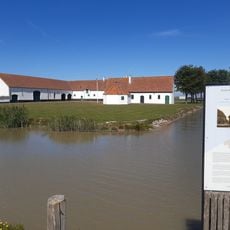
Walraversijde is a partially reconstructed medieval fishing village and open-air museum in the Raversijde district of Ostend, on the Belgian coast. The long pale-walled house with a steep thatched roof stands in a grassy field, with a white-walled section attached at its left. The site lies in a dune area near a medieval dyke, and the Walraversijde Museum holds the excavated finds.
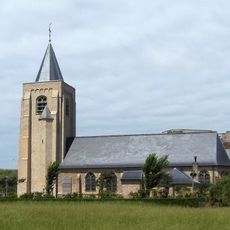
Walraversijde was first recorded in 1357 as 'Walravens Hide', a fishing hamlet behind the dunes. The Sint-Vincentius flood of 22 January 1394 broke the dune belt and submerged the original site, which was abandoned. In 1399 Duke John the Fearless ordered a new dyke, the Graaf Jansdijk, and a second village of about 100 brick houses grew behind it, with a brewery, a mill and a church built between 1420 and 1430.
The name Walraversijde comes from 'Walravens Hide', Old Saxon for the landing place of a certain Walraf, first recorded in 1357. Finds such as paradise grains, cloves, pepper, pomegranates, ivory combs and bronze candlesticks show that piracy, privateering and piloting Spanish ships to Bruges brought goods beyond a fishing village's means.
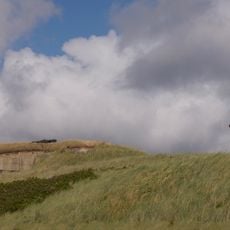
The site lies in the dunes just west of the Raversijde hamlet, a short drive from central Ostend, next to the Atlantikwall domain. Paths run through open ground between the reconstructed houses, so wear shoes suited to sand and grass and bring rain protection, as the coast is exposed to wind. The terrain is flat but partly unpaved.
Excavations started in 1992 and made this one of Europe's most thoroughly studied medieval fishing villages. Researchers have preserved and rebuilt so many details about seaside life from that period that few other sites compare in completeness.
The community of curious travelers
AroundUs brings together thousands of curated places, local tips, and hidden gems, enriched daily by 94,155 contributors worldwide.