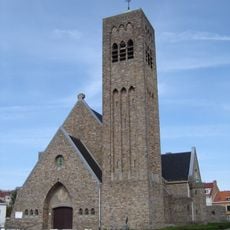
Onze-Lieve-Vrouw-ter-Duinenkerk, Gothic church in Mariakerke, Belgium.
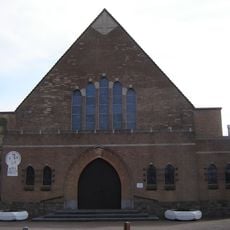
Onze-Lieve-Vrouw-ter-Duinenkerk is a single-nave Gothic brick church with a tall square west tower capped by a slate spire and a lower nave under a steep slate roof. Pointed-arch windows with dark tracery line the side walls, and a small stone porch projects from the nave. A sign reading "MARIAKERKE" sits on the roofline.
The site first appeared in records in 1071, when Count Robert the Frisian founded a chapel dedicated to the Virgin Mary. The structure evolved into the Gothic building that stands today and has survived through the centuries.
Locals call it the Duinenkerkje, the little dunes church. Inside are five ceiling paintings by Emmanuel Lacroix and a rococo wainscot of 42 panels by the Bruges craftsmen Frans Feys and Sebastiaan Wydau, installed after 1758. A 1594 baptismal font of Tournai stone also survives.
The church stands at the edge of Mariakerke in a protected dune and polder landscape, with the nave oriented west to east and the altar at the east end. The ground around the building was raised to its present level, so the church sits slightly above the surrounding dunes. The tower's pyramidal roof, rebuilt in 1638, carries a niche with a Marian statue and the date 1638.
The tower was probably flat-topped, like those of Damme and Lissewege, so a lookout could watch day and night and a fire beacon burned for sailors at night. The year 1638, when the west tower was rebuilt with a pyramidal roof, is carved in the niche with the Marian statue in the tower.
The community of curious travelers
AroundUs brings together thousands of curated places, local tips, and hidden gems, enriched daily by 93,439 contributors worldwide.