Venetiaanse Gaanderijen, Protected monument and arcade in Ostend, Belgium.
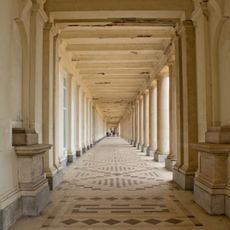
The Venetiaanse Gaanderijen is a covered gallery of pale stone built between 1900 and 1903 to a design by Henri Maquet. Along the Koning Boudewijn-promenade a lower wing of three tall arches, its roofline edged by a balustrade, meets a cylindrical tower with narrow windows and a dark ribbed dome. A second long gallery runs along the Parijsstraat, and at the 45-degree crossing of the two a large salon-like room fills the corner.
The galleries were built between 1900 and 1903 to a design by architect Henri Maquet, commissioned by King Leopold II on the site of the former Pavillon du Rhin restaurant and its oyster ponds. A secret underground tunnel linked them to the double villa of Baroness de Vaughan, the king's mistress, and was sealed after his death. Damaged in the Second World War, they lost their glass dome and marble mantelpiece.
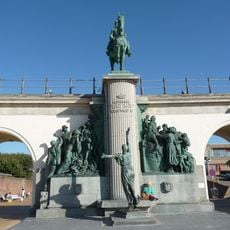
The city council uses the galleries as exhibition space, and part of the building is fitted out as a restaurant. On the terrace in front stands a bronze statue of King Baudouin, made in 1998 by the Ostend artist Josiane Vanhoutte (born 1946).
The galleries run along the Koning Boudewijn-promenade, formerly the Zeedijk, with a long covered gallery following Parijsstraat and a tower-like extension along Koningsstraat. The round tower on the promenade holds a wooden spiral staircase. Part of the building now serves as a restaurant, and a bronze statue of King Boudewijn (1998) by Josiane Vanhoutte stands on the terrace in front.
A tunnel once linked the galleries underground to the double villa at the corner of Parijsstraat and Koningsstraat, home to baroness de Vaughan, Leopold II's mistress. It was sealed after the king's death. The glass dome over the great salon and two glass extensions were removed during repairs after the Second World War.
The community of curious travelers
AroundUs brings together thousands of curated places, local tips, and hidden gems, enriched daily by 94,313 contributors worldwide.