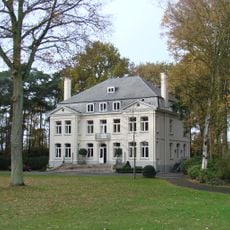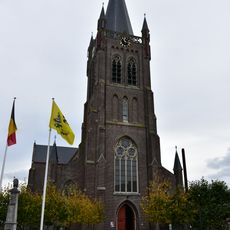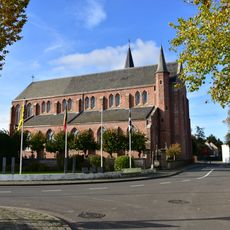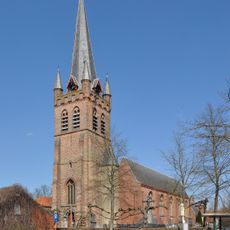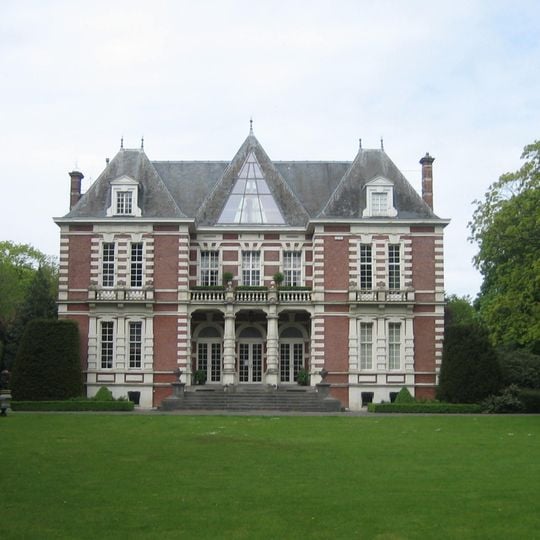
De Boeverie, Castle in Snellegem, Jabbeke, Belgium
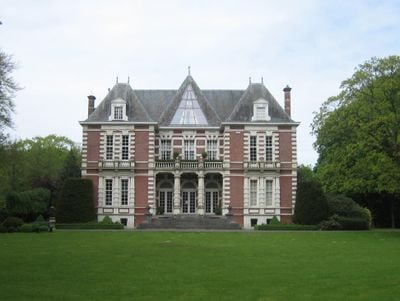
De Boeverie, also known as the castle of Snellegem, is a red-brick castle at Kasteeldreef 5-7 in Snellegem, part of Jabbeke. Built in 1874-1875 in eclectic style, its facade has white stone bands and window surrounds over three levels, six white columns supporting a central balcony, three gabled dormers in the slate roof and a triangular gable with a large multi-paned window. A four-step stone staircase leads to a recessed entrance with three doorways.
De Boeverie was built in 1874-1875 for Baron Edmond le Bailly de Tilleghem, east of the old Vlaeminckpoort estate, with an English landscape park laid out around it. In the 20th century it was home to Bénédict Gillès de Pélichy, his wife Adrienne le Bailly de Tilleghem and their nine children; both spouses served in turn as mayor of Snellegem. During the First World War the occupier built an airfield on the estate and housed German officers in the castle, which was damaged by Allied bombing; a 1927 fire in the cellar kitchen forced part of it to be rebuilt. The family sold the estate in 1961.
Two generations of the same family served as mayors of Snellegem from this house: Bénédict Gillès de Pélichy and his wife Adrienne le Bailly de Tilleghem, followed by their son Baudouin (1915-1997). The couple raised nine children here. The name De Boeverie refers to a farmstead, a reminder that the castle stood beside the older Vlaeminckpoort estate.
The castle stands at Kasteeldreef 5-7 in Snellegem, east of the former Vlaeminckpoort estate, and is a private residence, not a museum open to visitors. The English landscape park that once surrounded it was largely divided into plots and turned into a villa district, so the grounds are now a residential neighbourhood. The coach house with stables, the orangery and the serpentine pond belonged to that park.
The castle was built in 1874-1875 for Baron Edmond le Bailly de Tilleghem, east of the historic Vlaeminckpoort estate. In 1961 it was sold to Raoul Halewyck, an oyster and lobster farmer from Ostend, after which the building stood empty for a time and was occupied by hermits.
The community of curious travelers
AroundUs brings together thousands of curated places, local tips, and hidden gems, enriched daily by 94,232 contributors worldwide.