Kasteel Sipernau, Castle in Elen, Dilsen-Stokkem, Belgium
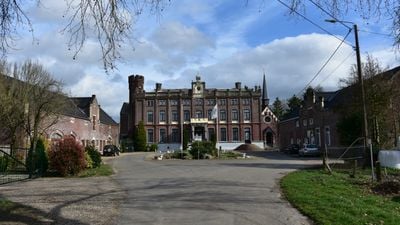
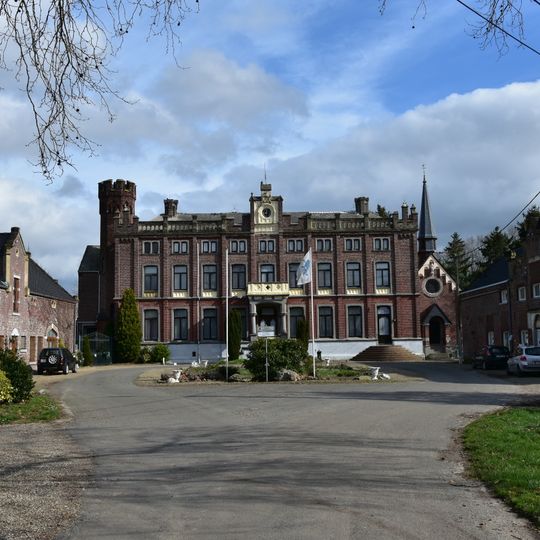
Kasteel Sipernau in Elen, Dilsen-Stokkem, is a long two-storey brick building with grey stone window surrounds, built in an early English neo-Gothic style by Baron Thomas Cornelius van der Marck (1705-1744). A square crenellated brick tower flanks the central section, which carries a round clock face under a small ornamental gable; a stone balcony projects above the entrance, and a narrow pointed spire rises at the right end. Knight Théodore Olislagers de Sipernau (1787-1861) added a storey and the tower.
Sipernau was a very old fief, going back to a Merovingian-era domain of the 8th century, and the castle itself is mentioned in 1179; the name Sipernau appears in 1259. In the 12th century it was held by the Abbey of Heylissem, then as a Loons fief by the families del Wege, van Mopertingen, de Rhoe (1510), van der Heyden (1710), van der Marck van Leur (1729) and de Lilien (1789). Baron Thomas Cornelius van der Marck (1705-1744) gave it its present 18th-century form, an early example of English-style neo-Gothic; knight Théodore Olislagers de Sipernau (1787-1861) added a storey and the tower. Since 2005 the castle, service buildings and farm are protected as a monument.
The name Sipernau appears in records from 1259, while the castle itself is mentioned as early as 1179. In the 15th and 16th centuries it was home to the knight Adam van Mopertingen. Since 2005 the castle, its service buildings and farm have been protected as a monument.
The castle stands in Elen, a village of Dilsen-Stokkem in Belgian Limburg, in the flat Maasland plain. The brick wings, grey stone trim, central clock gable, crenellated square tower and narrow spire at the right end are best read from the public approach; the doorway is reached by a short flight of railed steps. The castle, service buildings and farm have been a protected monument since 2005, so the buildings themselves are not open to walk through.
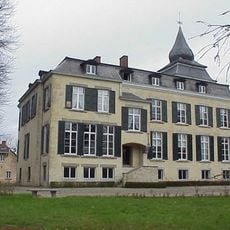
The front and rear facades of the 18th-century castle were built to look the same, an early English neo-Gothic feature. Knight Théodore Olislagers de Sipernau (1787-1861) later added a storey and the square crenellated tower, so the tower and extra floor are 19th-century additions to Baron Thomas Cornelius van der Marck's design.
The community of curious travelers
AroundUs brings together thousands of curated places, local tips, and hidden gems, enriched daily by 94,417 contributors worldwide.