Waulsort Abbey, Benedictine monastery in Waulsort, Belgium.
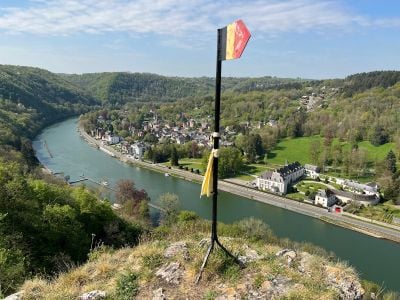
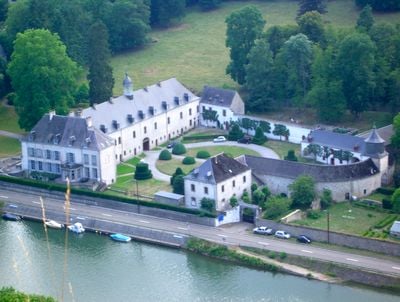
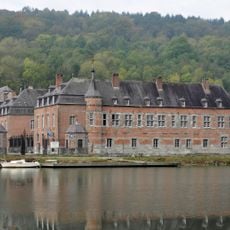
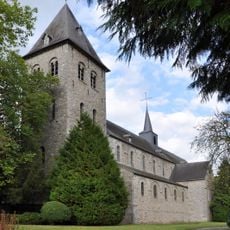
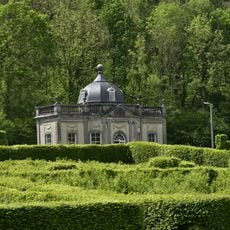
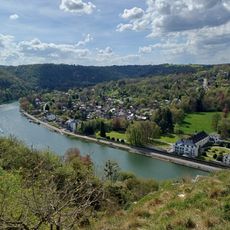
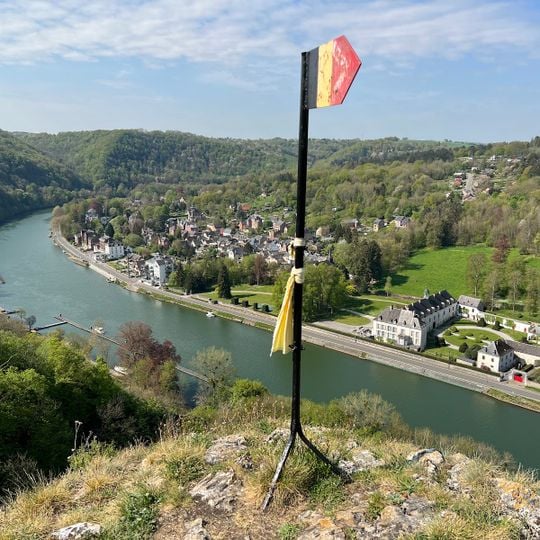
Waulsort Abbey stands on a slope above the Meuse, 10 km south of Dinant in the province of Namur. Its surviving buildings date from 1670: a long cream-coloured main block with grey shutters, a square tower topped by a dark domed lantern, and a lower wing with a slate mansard roof. A stone wall encloses a grassy courtyard.
The abbey was founded in 946 by Irish monks at the request of Eilbert de Florennes and developed into an important religious center. It remained active until its dissolution during the French Revolution at the end of the 18th century.
The abbey's name comes from its Latin form Walciodorus, used in Emperor Otto the Great's 946 charter. Its monks ran a goldsmithing school from the 10th to the 14th century, working in chasing, enamelling and engraving. The Lothair Crystal, an 11 cm crystal disc engraved with eight scenes from the story of Susanna, belonged to the abbey for nearly ten centuries.
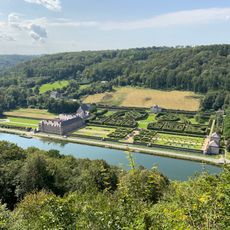
The former abbey is a private residence and cannot be visited. The surviving 17th-century buildings, including the abbot's palace, archive room, oval farmstead of 1727 and terraced gardens, stand above the Meuse about 10 km south of Dinant. They are seen from the riverbank or the road in Waulsort, in the Hastière municipality.
The Lothair Crystal, an 11 cm crystal disc engraved with eight scenes from the story of Susanna, belonged to the abbey for nearly ten centuries. Count Eilbert de Florennes left it here in repentance for a wrongful act. Thrown into the Meuse by looters in 1795, it was recovered and bought by the British Museum in 1855, where it remains.
The community of curious travelers
AroundUs brings together thousands of curated places, local tips, and hidden gems, enriched daily by 94,896 contributors worldwide.