Pavilion of Human Passions, Neoclassical pavilion in Parc du Cinquantenaire, Brussels, Belgium
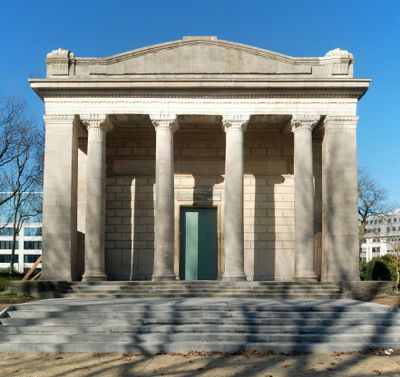
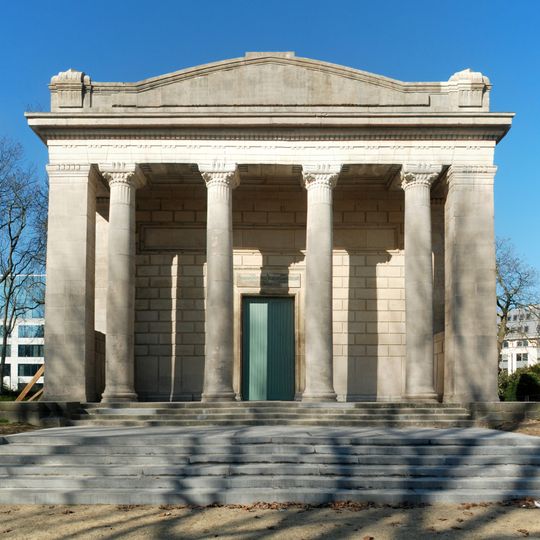
The Pavilion of Human Passions is a small neoclassical pavilion in the Parc du Cinquantenaire/Jubelpark of Brussels, built in the form of a Greek temple. Its symmetrical stone facade has a wide flight of grey steps, four tall fluted columns with carved capitals, a plain horizontal band and a shallow triangular pediment. Behind the columns a recessed doorway holds a green double door; inside, a wall built in 1909 hides Jef Lambeaux's marble relief, lit from the glass roof.
Victor Horta was commissioned in 1889, on Alphonse Balat's recommendation, to design a pavilion for Jef Lambeaux's relief The Human Passions. Built between 1891 and 1897 for the 1897 Brussels International Exposition, it opened unfinished in 1899 after a dispute over the facade. The wall hiding the relief was added in 1909, and the building reopened in 1910.
The pavilion was built to house The Human Passions, a monumental marble relief by Jef Lambeaux (1852–1908). A paper draft shown at the Ghent Triennial Salon of 1889 caused an immediate commotion. The work is inseparable from Horta's building, as the Royal Commission for Monuments and Sites stressed in 1980 when dismantling began.
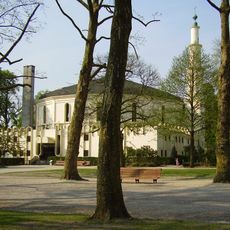
The pavilion stands in the Parc du Cinquantenaire/Jubelpark, near the Great Mosque and the East Pavilion. Since 2002 it has opened for one hour per day, except on Mondays, and it is managed by the Royal Museums of Art and History. Access is limited and has been restricted out of fear of vandalism rather than prudishness.
The pavilion was leased in 1967 by King Baudouin to King Faisal of Saudi Arabia for a planned Islamic art museum; the 1980 dismantling of the relief began without authorisation and was halted after a complaint, and the museum project was abandoned.
The community of curious travelers
AroundUs brings together thousands of curated places, local tips, and hidden gems, enriched daily by 93,461 contributors worldwide.