Art & History Museum, Archaeological and art museum in Cinquantenaire Park, Brussels, Belgium
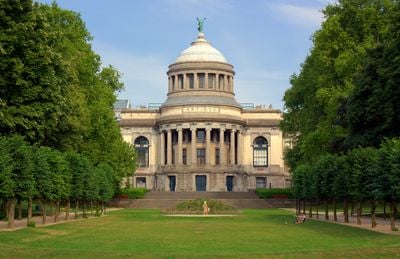
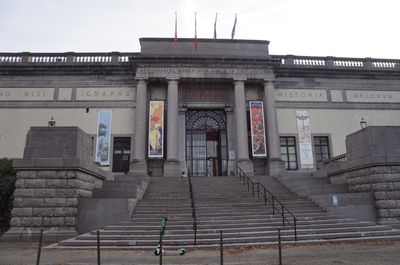
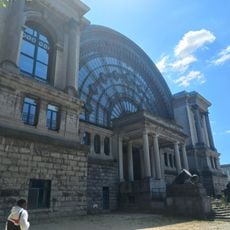
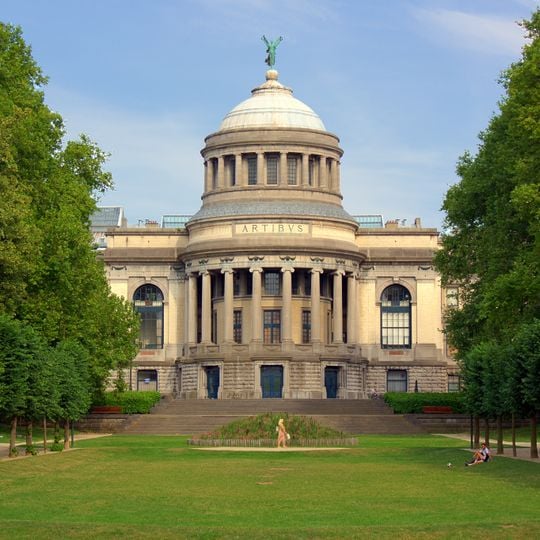
The Art & History Museum is a museum of antiquities, ethnography and decorative arts in Cinquantenaire Park, housed in a neoclassical building with a broad stepped base, a columned portico inscribed "ARTIBVS" and a central dome. Its four sections cover national archaeology, classical antiquity, non-European civilisations and European decorative arts.
The collections began with the Dukes of Burgundy and the Habsburg archdukes, then passed to the new Kingdom of Belgium in 1847 and were shown at the Halle Gate as the Royal Museum of Armour, Antiquities and Ethnology. In 1889 they moved to the Cinquantenaire, and in 1905 the south wing of the Bordiau Halls opened as the Pavillon de l'Antiquité. A short circuit started a fire on 19 January 1946 that destroyed the building; reconstruction, finished twenty years later, kept the original volumes, colours and materials.
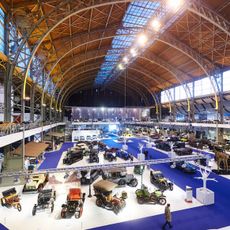
The museum displays artifacts from the Middle East, Egyptian mummies, Greek sculptures, Roman objects, Asian art, and Belgian decorative items spanning different periods. Visitors walk through galleries where artistic traditions from multiple cultures and eras are shown side by side.
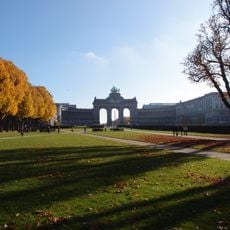
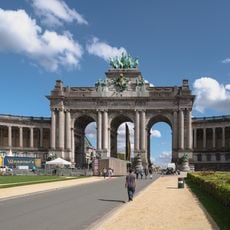
The museum occupies the south wing of the Bordiau halls in Cinquantenaire Park, entered from the side facing the park's central arch. The building is step-free at the main entrance, and lifts connect the floors. The nearest metro is Schuman or Merode; the park can also be crossed on foot from the European quarter.
The Easter Island sculpture Pou Hakanononga, a colossal figure of the tuna god, was brought back by the Belgian school ship Mercator in 1935. The museum also holds a large-scale model of 4th-century Rome made by the French architect Paul Bigot, and part of the Great Colonnade of Apamea in Syria.
The community of curious travelers
AroundUs brings together thousands of curated places, local tips, and hidden gems, enriched daily by 93,482 contributors worldwide.