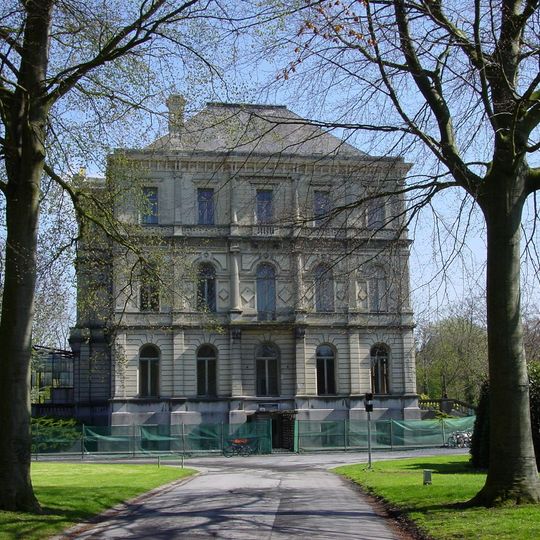
Kasteel de Lovie, Castle in Proven, Poperinge, Belgium
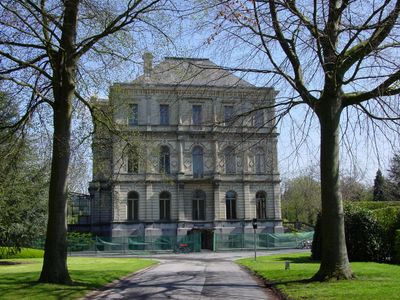
Kasteel de Lovie is a broad mansion of pale grey stone and brick built in 1856 by Kortrijk architect Pierre Nicolas Croquison for Jules van Merris of Poperinge. Its symmetrical facade has rows of tall rectangular windows with pale surrounds, a projecting central bay rising above the roofline under a steep dark roof, lower side wings, a small corner tower on the left and a few arched ground-floor openings. A low wall with short pillars and a green mesh fence runs across the front, with bare trees before it.
The castle was built in 1856 for Jules van Merris, designed by architect Pierre Nicolas Croquison. During the First World War it served as a command center for military operations in the region.
The estate is named after the De Lovie family, who owned the land before the castle was built. Jules van Merris, alderman of Poperinge, commissioned the building in 1856; after his death in 1899 it passed by public sale in 1912 to Count Joseph de Brouchoven de Bergeyck. Since 1929 it has belonged to the province of West Flanders.
The castle stands in Proven, a village within the municipality of Poperinge, and the Sixtusbos woods lie around De Lovie. The building itself is now the property of the De Lovie centre, which supports people with intellectual disabilities, so visits concern the grounds and exterior rather than the interior.
Queen Elisabeth visited the Saint-Idesbald sanatorium housed in the castle on 17 July 1932, during the years when the province of West Flanders ran the estate as a care institution.
The community of curious travelers
AroundUs brings together thousands of curated places, local tips, and hidden gems, enriched daily by 94,536 contributors worldwide.