Onze-Lieve-Vrouw van Kerselarekapel, Brutalist chapel in Kerselare, Belgium
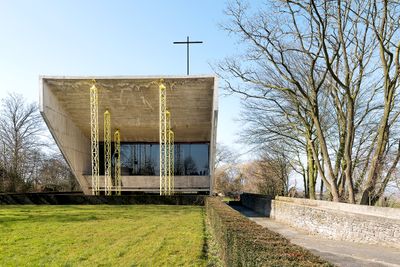
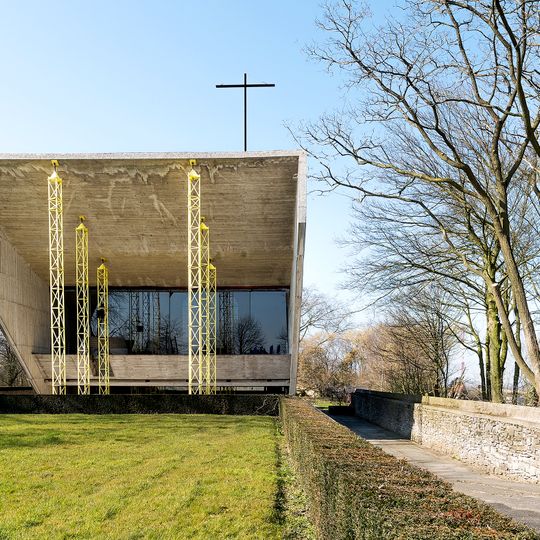
The Onze-Lieve-Vrouw van Kerselarekapel is a modernist chapel built from raw concrete featuring a sloped roof that extends into a covered entrance canopy. The open interior design allows clear sight lines from the altar to every corner of the space.
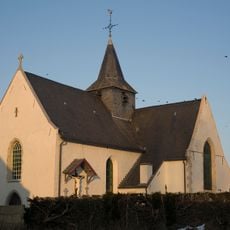
A legend places a small Marian statue in a cherry tree here in 1452, and a pilgrimage arose in the 15th century. The first stone was laid in 1457, the chapel consecrated in 1460, and in 1570 Jacob van Joigny, baron of Pamele, had it enlarged, the old chapel becoming a side choir. Fire destroyed the 15th-century chapel in 1961; only the statue was saved. An international competition was won by Juliaan Lampens, building started in 1963 and the first service was held in 1965.
The chapel is dedicated to Our Lady of Kerselare, crowned on behalf of the pope by Bishop Stillemans. A legend tells that in 1452 a small Marian statue was hung in a cherry tree, and a pilgrimage site grew there in the 15th century. A mummified crocodile, later replaced by a painted wooden one by sculptor Van Biesbroeck, hangs in the chapel as a votive.
The chapel can accommodate up to 1500 visitors during pilgrimages with accessible seating throughout the open layout. Its straightforward design makes it easy to move around and navigate for visitors of all abilities.
The 1570 enlargement was ordered by Jacob van Joigny, baron of Pamele, reportedly fulfilling a vow made by his father, who was attacked by a crocodile in Egypt. A embalmed crocodile hung in the chapel as a votive; in 1804 and 1860 it was replaced by a painted wooden crocodile carved by Van Biesbroeck.
The community of curious travelers
AroundUs brings together thousands of curated places, local tips, and hidden gems, enriched daily by 93,457 contributors worldwide.