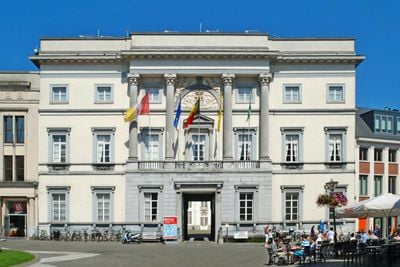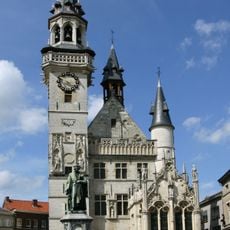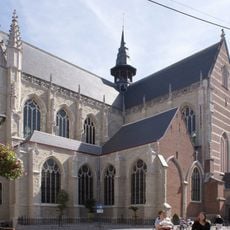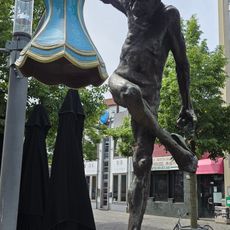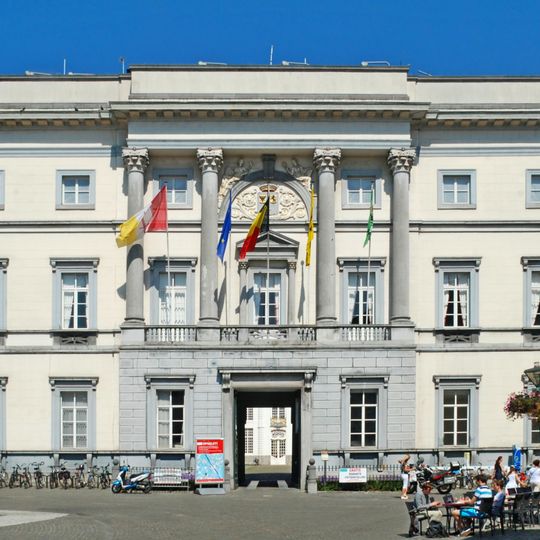
Stadhuis van Aalst, Neoclassical civic building in Grote Markt, Aalst, Belgium.
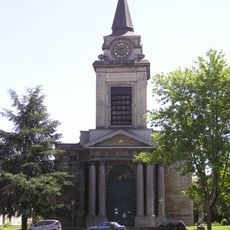
The Stadhuis van Aalst is a neoclassical town hall on Grote Markt with a symmetrical layout and prominent columns that frame its entrance. The structure combines brick, sandstone, bluestone, and plaster into a unified front.
The site began as a patrician house built in classical style in 1643-1645 by the Antwerp architect H. De Doncker, and was adapted and partly rebuilt in rococo style in the 18th century; the inner courtyard survives from these phases. The main facade on Grote Markt was erected in 1828-1830 in neoclassical style by Louis Roelandt. The building has been a listed monument since 19 June 1991.
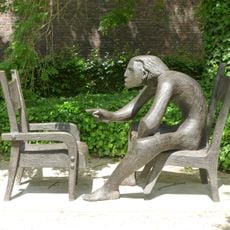
The rear wings around the paved courtyard are the 1643-1645 brick and sandstone buildings of the former Landhuis, residence of the Hoofdcollege of the Land van Aalst; the north wing was rebuilt in rococo style in 1756. Its clock gable carries a sundial and oculus, flanked by the 1830 memorial to the fallen. Until 2024 the bronze figure of Ondineke, heroine of Louis Paul Boon's De Kapellekensbaan, stood on the Landhuis facade.
The town hall sits directly on Grote Markt in the city center and is easy to reach on foot. Visitors can admire the exterior at any time, while views of the interior depend on opening hours for municipal services.
The bronze statuette of Ondineke, heroine of Louis Paul Boon's novel De Kapellekensbaan, stood on the Landhuis facade until 2024; it has since been moved to the sports complex 'Schotte' on the Kapellekensbaan. The rear courtyard also holds the 1830 memorial to the fallen, beside the main wing's scrolled gable with its sundial and oculus.
The community of curious travelers
AroundUs brings together thousands of curated places, local tips, and hidden gems, enriched daily by 94,520 contributors worldwide.