Schepenhuis, Gothic town hall and museum in Aalst, Belgium.
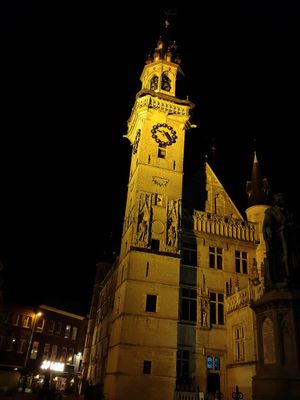
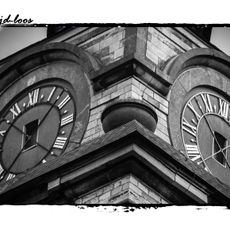
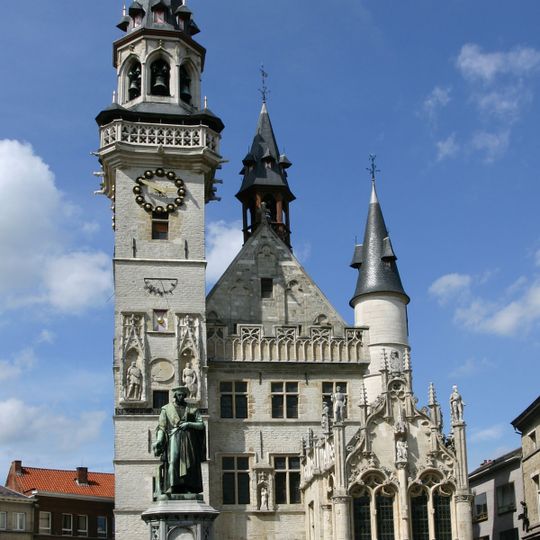
The Schepenhuis in Aalst is a 15th-century Gothic building on the Grote Markt, comprising the aldermen's house, a belfry and the protruding Gebiedshuisje. The belfry has a square bell tower with a black clock face and gold numerals, a balustraded gallery and a dark pointed roof; a slender round turret with a conical roof stands to the right.
Built in 1225 in Ledian sandstone, the Schepenhuis is likely the oldest surviving aldermen's house in the Low Countries. It was burned in 1380 during a Ghent revolt under Louis of Male and partly rebuilt, then damaged again by a fireworks fire on 7 July 1879. The belfry tower was added only in 1460, with a carillon; the front was restored after 1879 and its bells recast and enlarged from 38 to 52.
The name refers to the schepenen, aldermen who governed Aalst from this house. On the front of the belfry stand two statues representing the counts of Flanders and of Aalst, with a sundial of 1600 between them; above the motto Nec spe, nec metu (1555) are a warrior and a burgher, symbols of the old town's power and freedom.
The building stands on the Grote Markt, with the belfry tower at one corner and the late-Gothic wing facing the square. A 23-step staircase beneath that wing leads down to the cellars, now used as meeting or exhibition space. The carillon sounds every quarter of an hour.
The cellars under the Gebiedshuisje are reached by a 23-step staircase and were used as torture chambers, where the Jan de Lichte gang was tried. They now serve as a meeting and exhibition space, and for a time formed part of an escape room.
The community of curious travelers
AroundUs brings together thousands of curated places, local tips, and hidden gems, enriched daily by 94,115 contributors worldwide.