Onze-Lieve-Vrouw-Hemelvaartkerk, Gothic parish church in Damme, Belgium
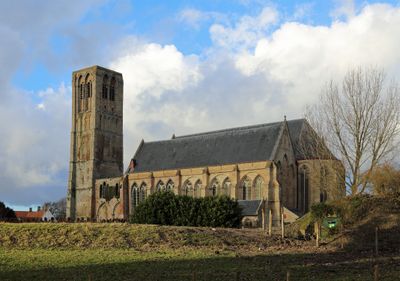
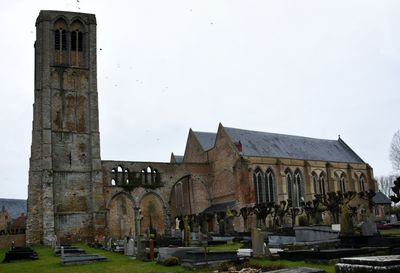
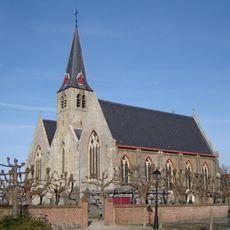
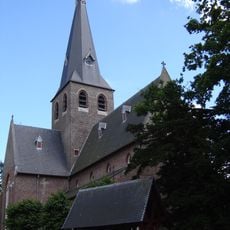
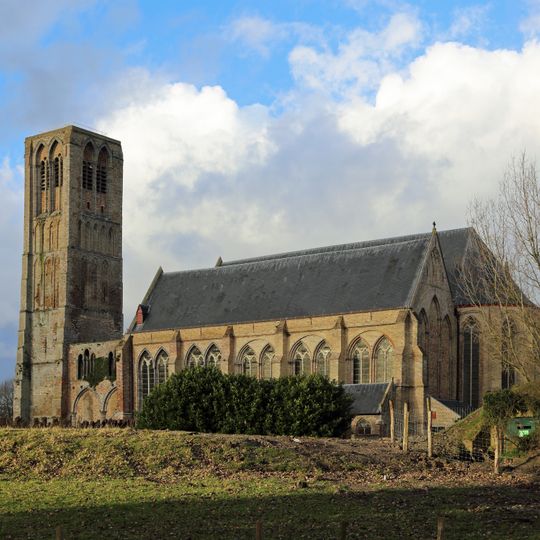
Onze-Lieve-Vrouw-Hemelvaartkerk is a partly demolished Gothic brick church in Damme. Its tall square tower rises in stages with paired pointed openings, while the nave wall continues into a roofless ruin pierced by pointed arches. The surviving choir, converted into a hall choir in the second half of the 13th century, is among the oldest of its kind in Flanders.
A chapel dedicated to Our Lady stood south of Damme around 1180, probably dependent on Oostkerke parish. Around 1210–1225 it became a three-aisled early Gothic basilica with a west tower, and the 13th–14th-century population growth brought side choirs and a hall choir. In 1725–1727 the nave, transept and tower spire were demolished, leaving the choir and two nave walls.
The church is dedicated to the Assumption of Mary, and its 14th-century apostle statues survived the plundering by the Geuzen in 1578. The late-Gothic rood screen, carved in 1555–1558 by the Bruges stonemasons Joos Aerts and Jan de Smet, was also spared. No services are held here today.
The church stands in a walled site southwest of Damme's centre, with the cemetery on its south side and a churchyard to the north. The nave and transept were demolished in 1725 and the tower spire in 1727, so there is no tower climb; the surviving choir and side choirs are viewed from ground level. No services were held here as of 2018.
The church keeps a late-Gothic rood screen (doksaal) made in 1555–1558 by the Bruges stonemasons Joos Aerts and Jan de Smet; it survived the plundering of 1578. Its lower part was built into the large porch erected before the central choir after the demolitions of 1725–1727.
The community of curious travelers
AroundUs brings together thousands of curated places, local tips, and hidden gems, enriched daily by 94,960 contributors worldwide.