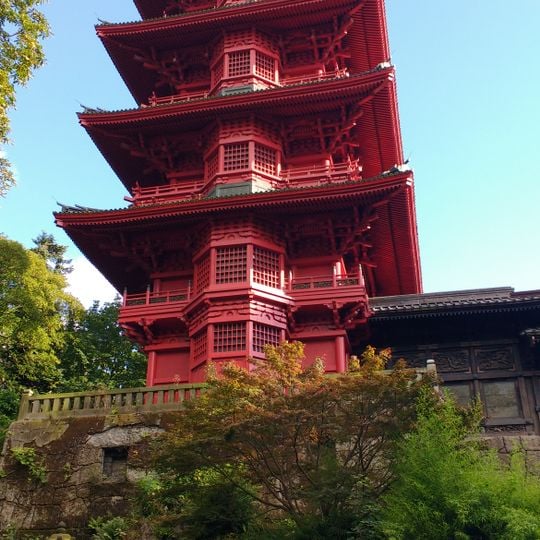
Japanese Tower, Historic pagoda in Laeken, Belgium
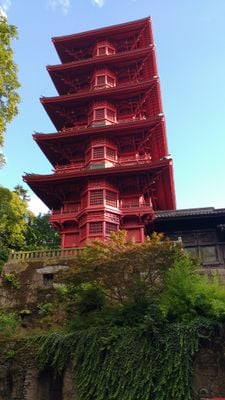
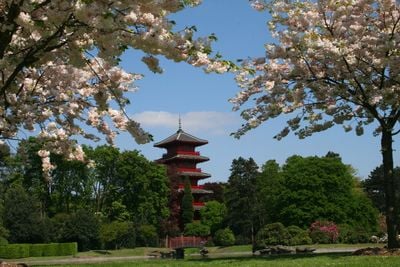
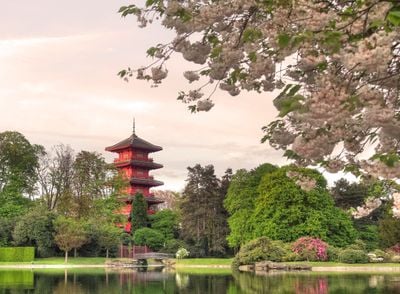
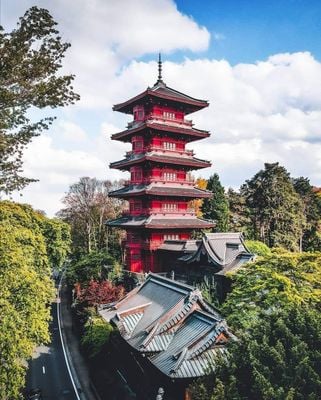
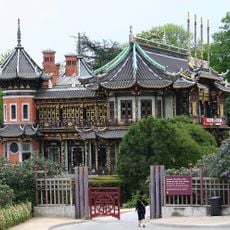
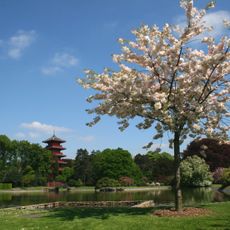
The Japanese Tower is a red-painted five-storey pagoda nearly 50 metres tall, standing across the road from the other Museums of the Far East buildings in Laeken. Belgian craftsmen built the main structure, first without nails in the Japanese manner until Alexandre Marcel ordered nails and wooden braces added. Maison Reynaud of Yokohama supplied most of the internal and external decoration, and the interior holds six chambers linked by a stairwell.
King Leopold II commissioned the structure after seeing Japanese architecture at the 1900 Paris Exposition, which inspired his design preferences. Construction took place between 1901 and 1904, reflecting his personal fascination with Far Eastern artistic traditions.
The tower's name appears in French as Tour japonaise and in Dutch as Japanse Toren. Its interiors were largely decorated by the Yokohama art dealer Maison Reynaud, and the first floor shows the legend of Urashima Taro, while the fourth floor, the "Red Floor", keeps red lacquered panels and a large matt Japanese painting on wood.
The tower stands across the road from the rest of the Museums of the Far East in Laeken, northern Brussels. It has been closed to the public since 2013 because of structural weaknesses, and in 2022 the federal government was reported to have decided not to reopen the complex. Visitors can still see the red facade and tiered roofs from the street.
The second floor, called the "Green Floor" or "Golden Floor", has aventurine applied to wide lacquered wall panels and shows mythical figures including dragons. Its painted vellum ceiling canopy, probably inspired by a woodblock print by Utagawa Kunisada, was removed and is now stored at the Art & History Museum in Brussels.
The community of curious travelers
AroundUs brings together thousands of curated places, local tips, and hidden gems, enriched daily by 94,972 contributors worldwide.