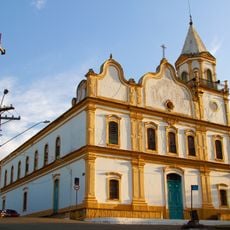
Historic center of Santana de Parnaíba, Colonial heritage district in Santana de Parnaíba, Brazil.
The historic center of Santana de Parnaíba is an old town district containing around 209 colonial-era buildings constructed with traditional rammed earth and wattle-and-daub methods. The layout features narrow paved streets, low-rise structures, and a central church that forms the heart of the community, creating a cohesive design from the 1800s.
The historic center grew from a chapel built on the banks of the Tietê River in the late 16th century. A first chapel dedicated to Santo Antônio went up around 1560; twenty years later a second was raised for Sant'Ana, and around 1610 André Fernandes built a third, elevated to parish church in 1625. The current Igreja Matriz dates from 1882. CONDEPHAAT and IPHAN listed the center, and in July 2007 a flood damaged it.
The name Santana de Parnaíba refers to Saint Anne, to whom the second chapel, built around 1580 by André Fernandes, was dedicated; it became the parish church in 1625. The town's bandeirista past is recalled in the Museu Casa do Anhanguera, a 17th-century urban residence attributed to Bartolomeu Bueno da Silva, the Anhanguera.
The neighborhood is best explored on foot since narrow streets make driving difficult and walking allows you to notice details of the buildings and layout. Comfortable shoes are recommended because the cobblestones are uneven, and afternoon heat can be intense.
The Museu Casa do Anhanguera, on Largo da Matriz, is the only urban bandeirante residence in São Paulo state to keep its original architecture, built in rammed earth and wattle-and-daub. It was listed by IPHAN in 1958 and is presumed to have been home to the bandeirante Bartolomeu Bueno da Silva, the Anhanguera.
The community of curious travelers
AroundUs brings together thousands of curated places, local tips, and hidden gems, enriched daily by 94,399 contributors worldwide.