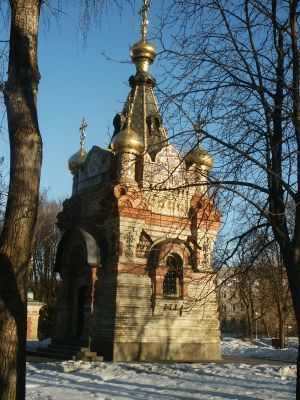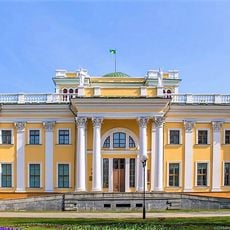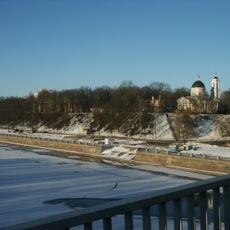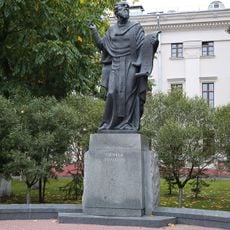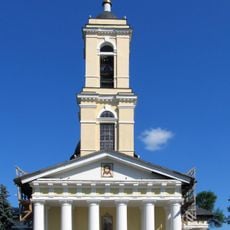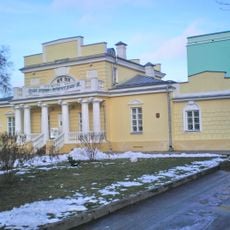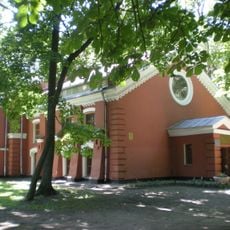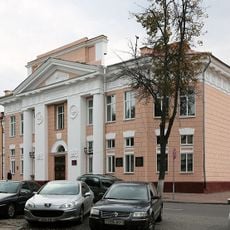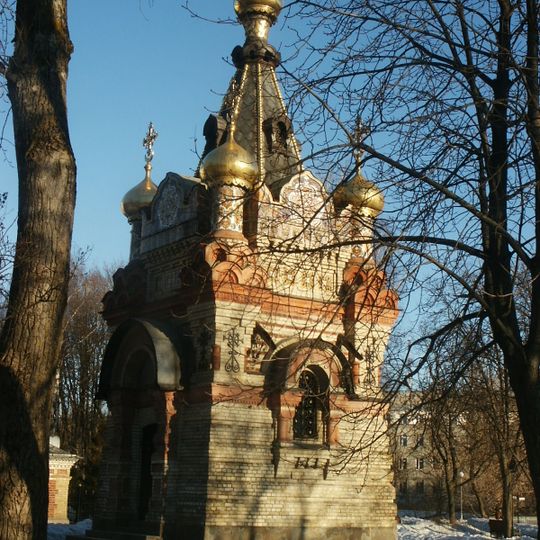
Paskevich burial chapel, Religious burial site in Gomel Palace Complex, Belarus.
The Paskevich burial chapel is a square building of 30 m² in the Gomel Palace Complex, built in the Russian style with a composition of five tented roofs and gilded cupolas. Its facades are covered with polychrome majolica tiles bearing plant ornament and an eight-pointed cross, made by local masters under the painter S. Sadikov. The south facade has an entrance with a staircase and an arched portal, and the burial vault lies underground, reached from a separate pavilion.
Construction of the chapel began in 1870 under architect Evgeny Czerwinski and took about 19 years to complete both the above-ground structure and the underground burial chamber. The building emerged as part of the palace complex's 19th-century development and reflects the architectural language of that Russian era.
The chapel's decoration was made by local craftsmen under painter S. Sadikov: polychrome paintings with Old Russian motifs, where flowers, leaves and shoots intertwine and an eight-pointed cross grows. Hollow ceramic columns, sculptural kokoshniks and majolica tiles with plant ornament cover the facades. Sadikov also supervised the gilding in the burial vault.
The burial vault lies underground, and its entrance is in a separate pavilion set some distance from the chapel, not inside the chapel itself. Visitors should look for that pavilion to reach the crypt, which holds eight members of the Paskevich family. The chapel stands beside the Peter and Paul Cathedral within the palace and park ensemble.
The chapel houses original cobalt-blue mosaic decoration that was once ordered from the renowned Eyduken Lewenstein factory in Saint Petersburg. This ornate embellishment exists only inside the burial chamber and remains preserved there, though it is absent from other parts of the structure.
The community of curious travelers
AroundUs brings together thousands of curated places, local tips, and hidden gems, enriched daily by 93,828 contributors worldwide.