Gomel Palace, Neoclassical palace in Gomel, Belarus.
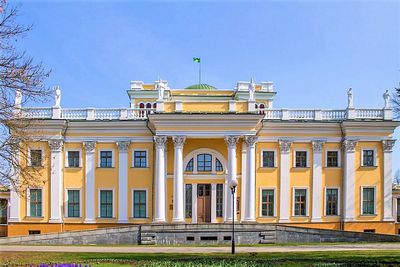
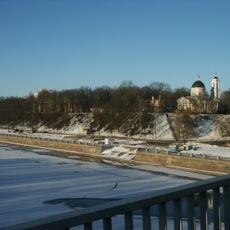
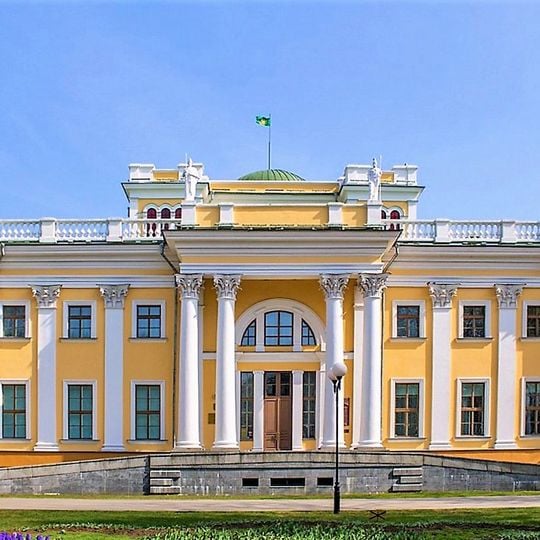
Gomel Palace is a two-storey neoclassical palace on a high base, its yellow facade with white trim centred on a four-column Corinthian portico with an arched entrance. A small tower with a green dome and flag rises above the roofline, and wings with pilasters and a balustrade extend to either side. It stands on the right bank of the Sozh River.
Catherine II granted the Gomel estate to Field Marshal Pyotr Rumyantsev in 1775; design work began in 1777, construction ran from 1785 to 1794, and the palace replaced a ruined wooden castle. In 1834 Ivan Paskevich bought it for 800,000 rubles and had Adam Idźkowski add a 32-metre tower and a third storey to the north wing. After 1917 the palace was nationalised for a museum.
The palace became a museum in 1919, when the confiscated Rumyantsev and Paskevich collections formed the core of the Gomel Regional Museum. Nicholas Rumyantsev's library, kept here, later became the basis of the Russian State Library in Moscow. A bronze equestrian statue of Prince Józef Poniatowski by Bertel Thorvaldsen stood on the park terrace from 1842 until 1921, when it was returned to Warsaw.
Visitors can explore three exhibition levels, including archaeological displays in the basement beneath the clock tower. Most rooms are connected by staircases, and the individual halls follow a marked route.
The facade carries six marble sculptures, each weighing over 1000 kilograms (about 2200 pounds), representing Greek deities and mythological figures. These statues were commissioned specifically for the palace and crafted in Saint Petersburg.
The community of curious travelers
AroundUs brings together thousands of curated places, local tips, and hidden gems, enriched daily by 93,850 contributors worldwide.