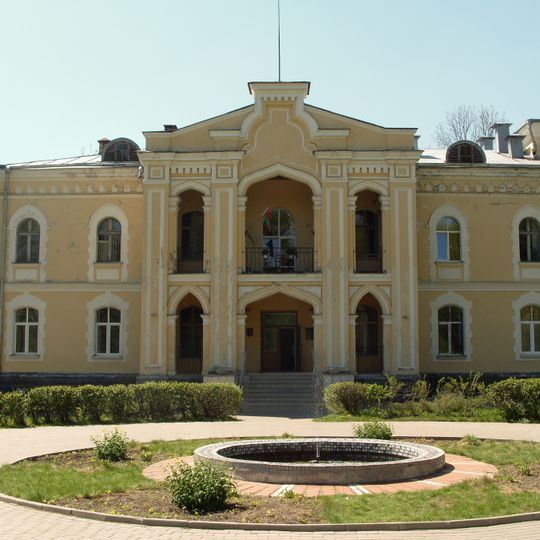
Čapski Palace, Pryluki, Palace complex in Pryluki, Belarus.
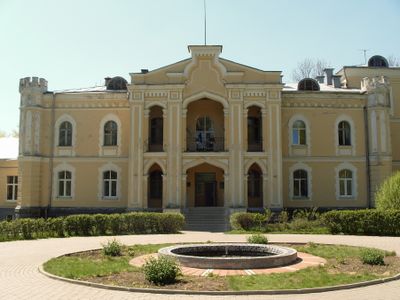
Čapski Palace is a palace complex in Pryluki that combines Russian pseudo-gothic and neoclassical architecture. The main building features symmetrical facades with columns and decorative patterns, surrounded by gardens and additional structures.
A monastery founded by Anna Oginskaya in the 1600s stood here until its closure in 1735, when the Ivanovskys settled on the site. The estate passed by dowry to Leon Osztorp and then to the agronomist Anton Horwatt, who built the Gothic-style palace with a large garden, an orangery and a clock tower. Emeryk Hutten-Czapski bought it in 1871 and reduced the towers to four in 1872; his son Jerzy added a dining hall after 1886. German troops burned the palace in July 1944, and it was rebuilt in the 1950s.
The estate's name comes from the Czapski family, who owned it from 1871, when Emeryk Hutten-Czapski bought it as part of lands stretching from Stańkowo to Minsk. Under his son Jerzy, writers Józef Czapski and Maria Czapska grew up here, and guests included composer Stanisław Moniuszko, painter Napoleon Orda and composer Michał Kleofas Ogiński.
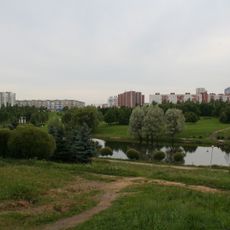
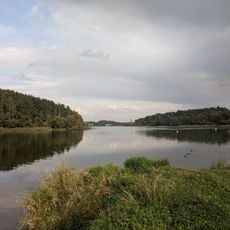
The palace stands on a high hill above the Ptič floodplain, with four Italian-garden terraces dropping steeply toward the river; the ground is uneven, so wear sturdy shoes. The ensemble belongs to the Research Institute of Plant Protection, so the interiors are not open as a museum and visits focus on the exterior and park.
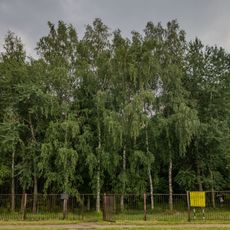
The palace's clock tower, a three-tiered structure with a spire and weathervane, was destroyed in World War II and never rebuilt. The park lost many trees in a 2016 hurricane, but the palace itself was untouched.
The community of curious travelers
AroundUs brings together thousands of curated places, local tips, and hidden gems, enriched daily by 94,542 contributors worldwide.