Fort George, British military fort in Niagara-on-the-Lake, Canada.
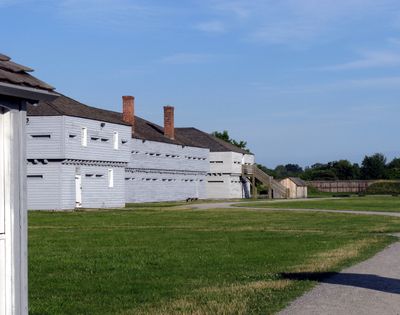
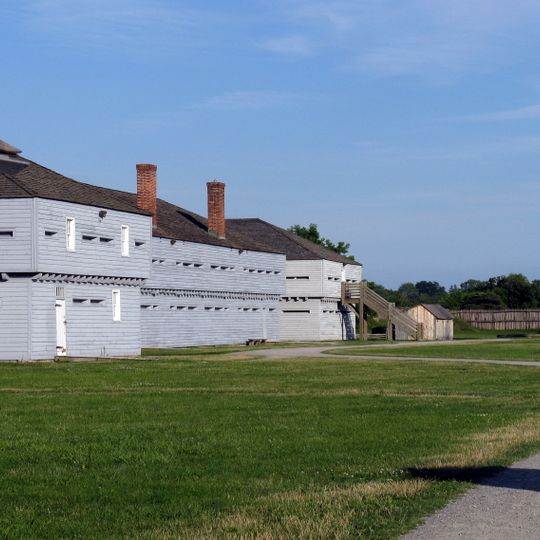
Fort George is a reconstruction of the British fort built in the 1790s on the Niagara River at Niagara-on-the-Lake. Its irregular earthwork has six bastions, and inside are reconstructed wooden buildings, including barracks with white horizontal siding, dark shingled roofs and two red brick chimneys. A covered walkway links two of the white sections.
The British began Fort George in 1796 after the Jay Treaty forced them to leave Fort Niagara, completing it that year with a blockhouse, a stone gunpowder magazine and two warehouses. In May 1813 American artillery destroyed its log buildings, and US troops occupied the site for seven months. The British regained it in December 1813 but built Fort Mississauga instead in the 1820s. The Niagara Parks Commission reconstructed the fort in the late 1930s, and it opened in 1940.
The fort functions as a living history space where visitors watch costumed interpreters demonstrate how soldiers lived and worked in the 19th century. You can observe traditional crafts, cooking methods, and the rhythms of garrison life as people experienced it then.
The site is open daily from May through September with regular tours led by costumed interpreters. Allow time to walk the grounds and observe demonstrations, and note that summer weekends tend to have more activities and larger crowds.
The stone gunpowder magazine is the only building at Fort George that dates to the original fort, not to the 1930s reconstruction. It was among the structures Major-General Isaac Brock proposed to abandon in his plan to shrink the oversized fort, and it was not spared the War of 1812: the log buildings were destroyed in the bombardments and the Battle of Fort George in 1813.
The community of curious travelers
AroundUs brings together thousands of curated places, local tips, and hidden gems, enriched daily by 94,055 contributors worldwide.