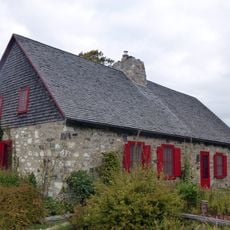
Maison Morisset, Historic farmhouse in Sainte-Famille-de-l'Île-d'Orléans, Canada.
Maison Morisset is a farmhouse built around 1678, reputed to be the oldest stone house in Quebec. Its walls are entirely of stone, including the gable ends, which are usually wooden on other surviving houses. The interior follows a French rural layout: a single common room with a monumental hearth, a closed dairy in the northeast corner, and a ladder-like stair to the attic. A bread oven with trapped heat opens onto the hearth.
Built in 1678 by Jean Morisset during the New France era, it stands as one of the oldest surviving residential structures in the region. Official heritage recognition came in 1962 when Quebec's Ministry of Culture and Communications designated it as a protected site.
The house's nickname, La Brimbale, refers to the bramble that grew around it. Its interior follows a French peasant layout: a single common room with a monumental hearth, a dairy in the northeast corner, and a ladder-like stair to the attic. The bread oven held its heat, with smoke escaping through the oven mouth into the fireplace flue.
The house stands on Chemin Royal in Sainte-Famille, on Île d'Orléans, and is a private residence, so it is seen from the road rather than visited inside. Its gable walls of stone and the dormer windows are best observed from the public roadside. The interior hearth and bread oven are not open to visitors.
The house appears on the cover of Yves Thériault's novel La Fille Laide, and it has served as a set for several television productions. Musicians Gilles Vigneault and Félix Leclerc both performed there in 1963, followed by violinist Angèle Dubeau in 1988 and singer Natalie Choquette in 1993.
The community of curious travelers
AroundUs brings together thousands of curated places, local tips, and hidden gems, enriched daily by 93,811 contributors worldwide.