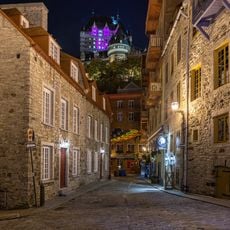
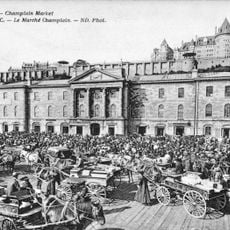
Habitation de Québec, Archaeological site in Old Quebec, Canada
The Habitation de Québec is an archaeological site in Old Quebec showing remains of the first permanent French settlement in North America. Excavations have uncovered timber structures and stone foundations situated near the St. Lawrence River that reveal the original layout of the colony.
Samuel de Champlain landed at the foot of Cap Diamant on 3 July 1608 and built a fur-trading post for Pierre Du Gua de Monts. The first winter killed 20 of 28 men, mainly from scurvy. Completed in 1609 with three two-storey lodges, a gallery, garden, moat and palisade, it was rebuilt in stone in 1626–1627, burned in 1632 and rebuilt in 1633.
The site's name appears in Middle French as "Abitation de Quebecq", and the compound served as fort, fur warehouse and lodging. A commemorative plaque on the exterior wall of Notre-Dame-des-Victoires church recalls Champlain's founding of Quebec on 3 July 1608 and the Habitation erected on the same spot.
The site is accessible year-round with guided tours that explain colonial architecture and artifacts recovered during excavations. Tours help visitors understand these objects in the context of how they were originally used and positioned.
The first winter of 1608-1609 killed 20 of the 28 men at the Habitation, mostly from scurvy. Champlain had the original wooden buildings demolished in 1624 and rebuilt in stone in 1626-1627, with the arms of the king, the viceroy and Champlain carved on them. Excavations in 1975-1978 uncovered the remains, now displayed in the basement of Notre-Dame-des-Victoires church.
The community of curious travelers
AroundUs brings together thousands of curated places, local tips, and hidden gems, enriched daily by 94,226 contributors worldwide.