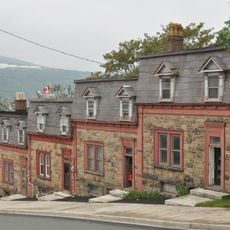
Anderson House, Heritage house in St. John's, Canada.
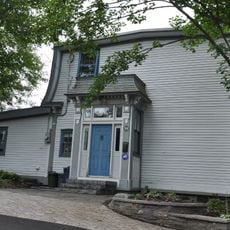
Anderson House is a wooden two-and-a-half-story building with a hip roof and symmetrical front at Powers Court. Inside, original features remain including a large kitchen fireplace, traditional mantels, narrow clapboard siding, and wooden roof shingles.
The building was constructed around 1804 as a residence for Sergeant James Anderson and later served military officers as barracks. This makes it an important example of the city's early architecture.
The house takes its name from Sergeant James Anderson, a Bombardier with the Royal Regiment of Artillery by 1797 and a Sergeant by 1811. Oral history holds that part of the building stabled horses when it served as a military barracks. In 1860 it was bought by Henry C. Tillmann, a Halifax-born music professor and composer of "The Newfoundland Camp Gallopade" (1853).
Anderson House stands at 42 Powers Court, up the hill from the St. John's waterfront near Signal Hill Road. The building is closed to the public and its interior cannot be visited; the restored exterior, with its wooden shingles and rebuilt chimney, is seen from the lane. The surrounding lanes are steep and uneven underfoot.
Anderson House kept most of its interior fabric from the early 1800s: a spiral staircase rising to an unchanged attic, a kitchen fireplace with coal grate and cooking crane, and mantels believed original. Heritage advocate Shane O'Dea noted this in 1974, before a fire that October damaged the empty building.
The community of curious travelers
AroundUs brings together thousands of curated places, local tips, and hidden gems, enriched daily by 93,076 contributors worldwide.