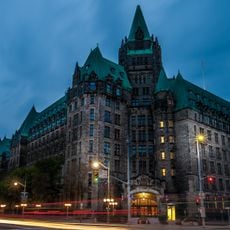
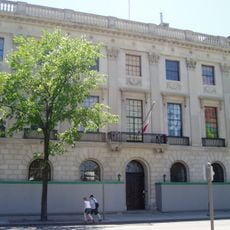
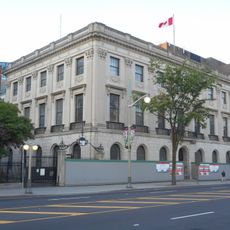
Second Supreme Court of Canada Building, Federal judicial building at Wellington Street, Ottawa, Canada
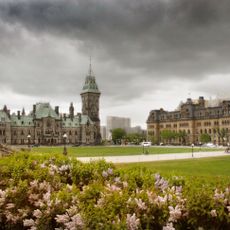
The Second Supreme Court of Canada Building stood at the southwest corner of the West Block, west of Parliament Hill in Ottawa. Chief Dominion Architect Thomas Seaton Scott designed it in 1873–74 as workshops and stables for the Department of Public Works, in a subdued Gothic Revival style less ornate than the neighbouring West and East Blocks. Thomas Fuller renovated it for judicial use in 1881, and a north wing added in 1890 nearly doubled its size with a basement, two storeys and an attic.
Built in 1873–74 by Chief Dominion Architect Thomas Seaton Scott as workshops and stables for the Department of Public Works, the building was renovated for judicial use by Thomas Fuller in 1881. The Supreme Court moved in in 1882, sharing the premises with the National Art Gallery until 1887, and a north wing nearly doubled its size in 1890. Judges complained of a dreadful smell, poor ventilation and cramped quarters, and after the Court left, the building was demolished in 1956 despite appeals from John G. Diefenbaker and Mayor Charlotte Whitton.
The building shared its premises with the National Art Gallery from 1882 to 1887, so courtrooms and exhibition space stood under one roof. Judges complained of a persistent "dreadful smell", poor ventilation and cramped quarters, and the distance from the Library of Parliament. A north wing added in 1890 nearly doubled its size with a basement, two storeys and an attic.
The building no longer exists: it stood at the southwest corner of the West Block, west of Parliament Hill, and was demolished in 1956. Its site is now a parking lot and vehicle screening facility for Parliament Hill, so there is nothing to enter or visit. Look for the open ground between West Block and the Library and Archives Canada building.
The building was designed by Thomas Seaton Scott as workshops and stables for the Department of Public Works, and was considered less ornate than other federal buildings in Ottawa. A 1936 Maclean's article noted that even the "shoddy little" courthouse could not rob the institution of the reverence it inspired.
The community of curious travelers
AroundUs brings together thousands of curated places, local tips, and hidden gems, enriched daily by 92,622 contributors worldwide.