Beebe Plain Border Crossing, International border crossing in northeastern Vermont and southern Quebec.
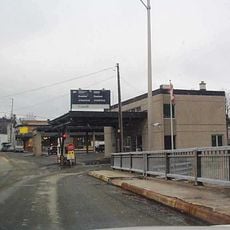
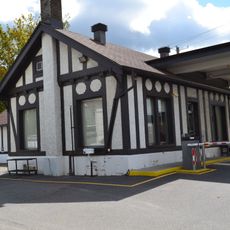
The Beebe Plain Border Crossing consists of two separate stations: the Canadian station, a Tudor Revival structure built in 1932 at the northeast corner of Canusa Street and Rue Principale, and the US station, a single-story brick building from 1937 at the southeast corner of Canusa Street and Beebe Road. The US station is five bays wide, with double sash windows in the outer bays, single sash windows in the inner bays, and a central entrance. A single-lane porte-cochere with a cross-gabled roof extends over the travel lane.
The US station was built in 1937 as a single-story brick building with a side gable roof and end chimneys; it is one of four surviving buildings of this type on American borders and was listed on the National Register of Historic Places in 2014. The Canadian station, a Tudor Revival structure of 1932 at the northeast corner of Canusa Street and Rue Principale, was recognized as a Federal Heritage Building in 1991 and renamed the Stanstead-Beebe station after Stanstead was formed in 1995.
Canusa Street runs directly along the border, with houses on one side in the United States and houses on the other side in Canada. Residents who want to visit a neighbor across the street must go through an official border crossing to do so.
The crossing is open around the clock and does not use specialized programs like NEXUS or FAST. Travelers should carry valid travel documents and expect possible waits when traffic is heavy.
From 1864 until the early 1900s, an international post office with two separate doors operated at this spot, one for American customers and one for Canadian customers. That setup let both countries offer postal services side by side without requiring anyone to formally cross the border.
The community of curious travelers
AroundUs brings together thousands of curated places, local tips, and hidden gems, enriched daily by 92,777 contributors worldwide.