Ramparts of Quebec City, City walls in La Cité-Limoilou, Canada.
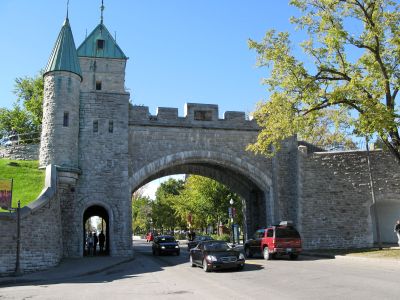
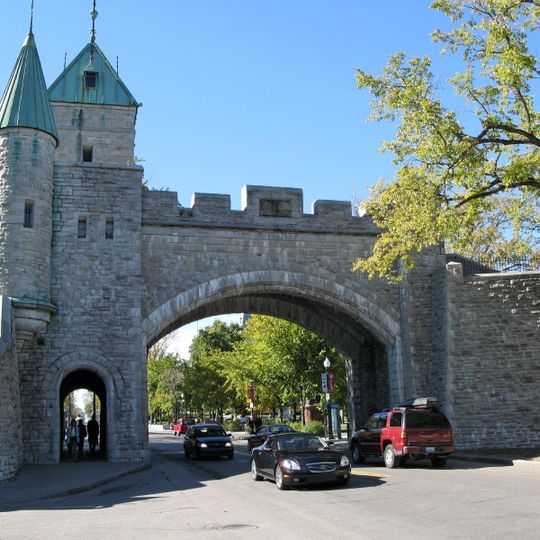
The Ramparts of Quebec City are a city wall of rough-cut grey stone enclosing the western end of Old Quebec's Upper Town, running 4.6 kilometres; the southern sections form part of the Citadelle. The wall has a flat, crenellated top with rounded bastions, and its gates include a large round arch for vehicles beside a smaller pointed arch cut into the base of a round tower with a steep dark-green conical roof, next to a square tower with a pyramidal roof.
Quebec's first real walls went up in 1690, after Port Royal fell, and were improved in 1693 as 11 redoubts linked by palisades. In 1745, after Louisbourg was taken, Governor Beauharnois ordered a masonry enceinte built further west to designs by Chaussegros de Léry. British engineers extended it from 1820, completing the Citadelle by the late 1830s; about 300 cannon stood on the walls in 1837.
The four gates carry names tied to the city's past: Porte Saint-Jean and Porte Saint-Louis date from 1694, Porte Prescott from 1797, and Porte Kent from 1879, named for Queen Victoria's father. All were torn down around 1871 and later rebuilt, the last of them in 1983. Lord Dufferin, governor general from 1872 to 1878, pressed for their reconstruction.
The upper walkway is accessible by stairs at several gates, including Porte Saint-Louis and near Terrasse Dufferin, and remains open for walking throughout the year. In winter, snow and ice can make the paths slippery, so visitors should wear sturdy footwear and bring walking poles if needed.
The four gates standing today are not the originals: Porte Saint-Jean was rebuilt in 1939, Porte Saint-Louis around 1880, Porte Prescott in 1983 and Porte Kent dates from 1879. Lord Dufferin, governor general from 1872 to 1878, pushed to have the demolished gates rebuilt. About 300 cannon pieces were placed along the rampart in 1837.
The community of curious travelers
AroundUs brings together thousands of curated places, local tips, and hidden gems, enriched daily by 93,782 contributors worldwide.