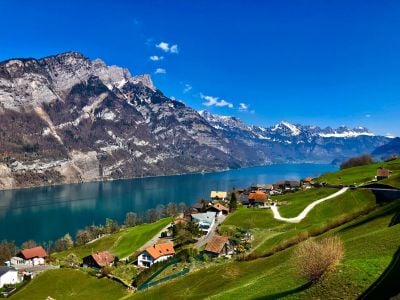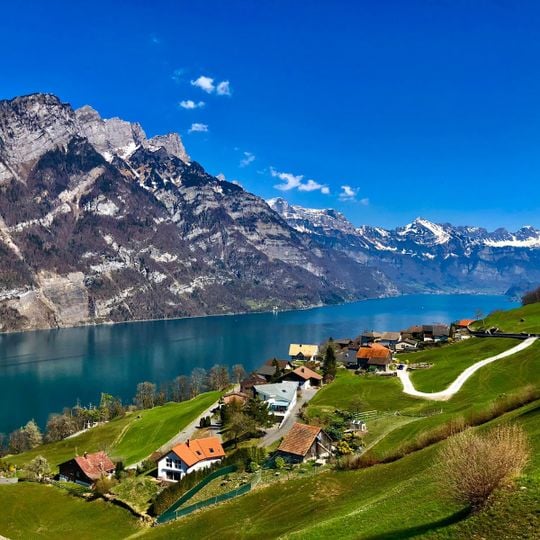
Walensee, Mountain lake between Glarus and St. Gallen cantons, Switzerland
The Walensee is a lake in the eastern Swiss Prealps, about two thirds in the canton of St. Gallen and one third in Glarus. It lies at 419 m in a valley trough shaped by the Rhine Glacier, is 24 km² in area and reaches 151 m in depth. The Churfirsten range rises on the north side to 2,306 m; the south shore carries the A3 motorway and the Ziegelbrücke–Sargans railway.
First recorded in 843 as "lacu riuano", the lake formed the early medieval language border between the Alemanni in the west and the Romansh, called Welschen, in the east, which gave the German name its meaning. Until the Linth regulation of 1807–1811, the Linth bypassed the lake and the Maag was its outflow; the Escher canal then made the Linth the main tributary, enlarging the catchment and lowering the water level by 5.5 m.
The name Walensee means "Lake of the Welschen", marking the early medieval border between the Alemanni in the west and the Romansh speakers in the east; it was first recorded in 843 as lacu riuano. On the northern shore, the mild climate of Quinten, reachable only by boat or on foot, allows palm trees, figs, kiwifruit and vineyards to grow. Franz Liszt set the lake to music in his piano piece "Au lac de Wallenstadt", written after his travels in Switzerland in the 1830s.
Most villages around the lake are accessible by train or car, though some remote spots require hiking or boat travel to reach. Wear proper footwear and check the weather, as conditions on mountain trails can change quickly.
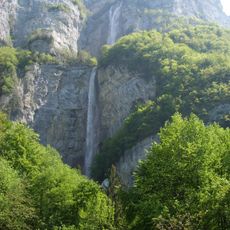
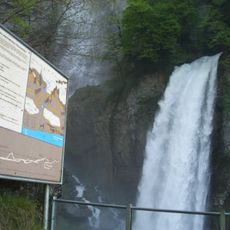
The Schnittlauchinsel, near the eastern end of the lake in the municipality of Quarten, is the only island in the Walensee. The Seerenbach Falls and the Rinquelle spring lie on the northern shore. Franz Liszt was inspired by the lake in the 1830s to write the piano piece "Au lac de Wallenstadt".
The community of curious travelers
AroundUs brings together thousands of curated places, local tips, and hidden gems, enriched daily by 94,466 contributors worldwide.