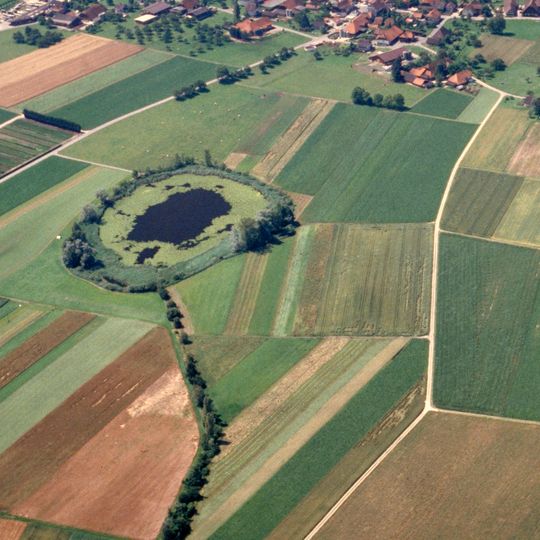
Lobsigensee, Kettle lake and archaeological site in Seedorf, Switzerland
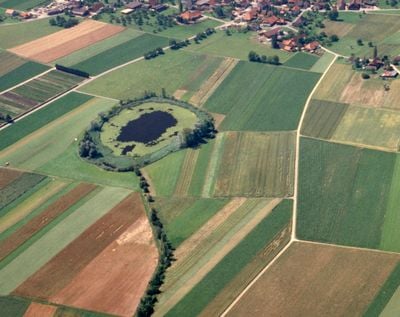
Lobsigensee is a small kettle lake and archaeological site in Seedorf, canton of Bern, with a surface area of 1.73 ha. It lies on a 500 m × 2100 m plateau on the north slope of the Frienisberg, about 500 m northeast of Lobsigen and 1100 m southwest of Seedorf. A 10–40 m wide belt of reeds, cattails and fen surrounds the water, and a raised wooden viewing platform stands on the southeastern shore.
Archaeological excavations began in 1908 at Lobsigensee and revealed multiple prehistoric settlements dating to the fourth millennium before Christ. These discoveries made the site part of the UNESCO World Heritage designation for prehistoric pile dwelling settlements around the Alps.
The pile-dwelling remains lie on the southwestern shore and are dated to the second half of the 4th millennium BC. Private collectors began finding artifacts there in the 1950s, and the site is now part of the UNESCO Prehistoric Pile dwellings around the Alps.
The lake lies about 100 m north of Lobsigen's Unterdorfstrasse, reached by a field path; a partly marked footpath circles the water. PostAuto line 105 (Bern–Lyss) stops nearby, and the main road 236 Aarberg–Bern passes through Seedorf. A raised wooden viewing platform on the southeastern shore looks over the pond. Swimming, boating and fishing are prohibited in the protected area.
Test borings from 2005 revealed a charred layer indicating a settlement destroyed by fire. This surprising discovery helped archaeologists better understand the inhabitants and the events of their time.
The community of curious travelers
AroundUs brings together thousands of curated places, local tips, and hidden gems, enriched daily by 94,018 contributors worldwide.