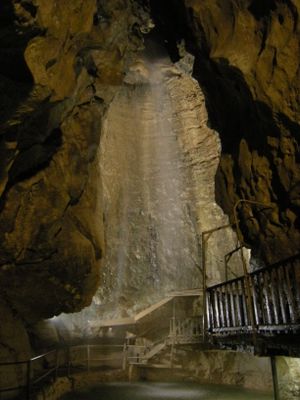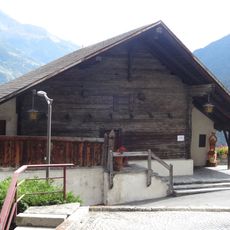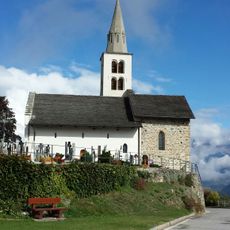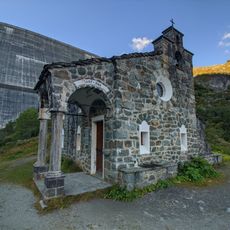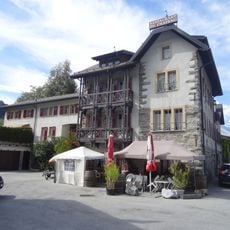
Grotte aux Fées, Show cave in Hérémence, Switzerland.
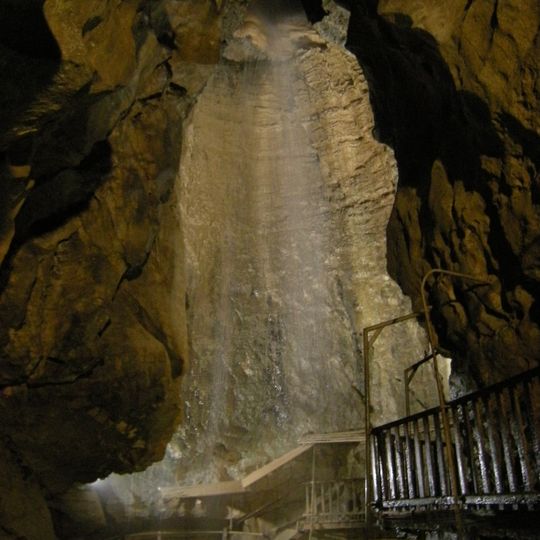
Grotte aux Fées is a naturally formed cave with limestone galleries extending about half a kilometer underground. The passages lead to an underground lake where a waterfall descends into the water.
The cave was known from Roman times and was used as a sheepfold, called Trou aux Fayes, until the mid-19th century. In 1831 two Bernese explorers, Haller and Ott, mapped about 600 metres of passages. From 1863 Canon Gard of the Abbey College of Saint-Maurice cleared the galleries and ran tours for his orphanage; from 1865 the Sisters of Saint-Maurice operated it and gave it its present name.
The name evolved from Trou aux Fayes, meaning "sheep hole" in the local patois, because shepherds sheltered their flocks there during storms. In the second half of the 19th century locals called it Trou des Fées, and the present name was adopted after the tourist gallery was fitted out, chosen to sound more poetic in the Romantic era. Past names for cave sections evoked Hell: marmite du Diable, pont du Diable, Styx, grotte du Tartare, galerie des Morts.
The cave has established pathways with lighting systems, so sturdy footwear is important for the uneven surfaces. Visitors should prepare for cool conditions and bring a light jacket.
The cave was long called Trou aux Fayes, "sheep hole" in local dialect, because shepherds sheltered their flocks there during storms. In 1864 François-Alphonse Forel analysed the air of the Galerie des Morts, where flames kept going out, finding 1.99% CO2. In 1886 four explorers left a message in a bottle in an unexplored passage.
The community of curious travelers
AroundUs brings together thousands of curated places, local tips, and hidden gems, enriched daily by 92,853 contributors worldwide.