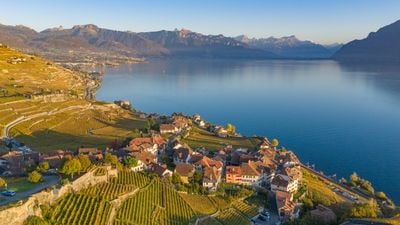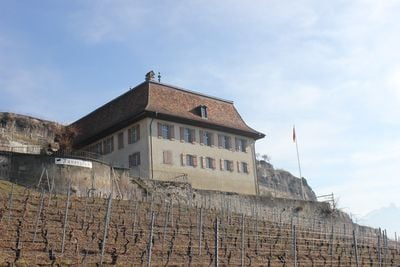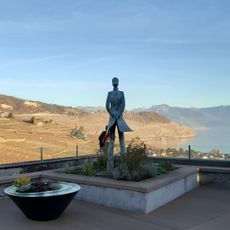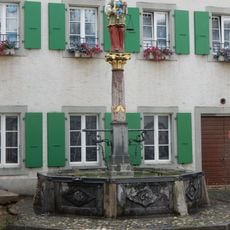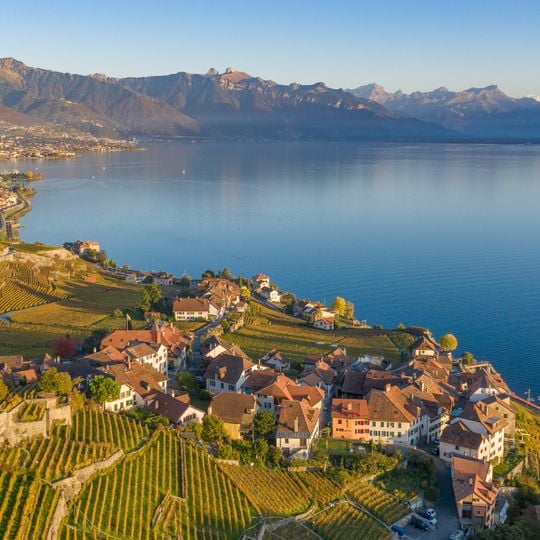
Lavaux, Wine terraces in Vaud, Switzerland.
Lavaux is a region of terraced vineyards covering 830 hectares along about 30 kilometres of the north shore of Lake Geneva, between Lutry and Vevey. Narrow parallel rows of Chasselas vines step down the slope in plots held by rough stone walls, locally called charmurs, with pale-walled houses and brown tiled roofs clustered where the slope meets the water.
Lavaux's terraced vineyards date to the 11th century, when Benedictine and Cistercian monasteries held the land. The name appears only from the 12th century, when a bull of Innocent II mentions the vallis de Lustriaco, the valley of Lutry; the spelling Lavaux emerged in the 16th century. The stone walls, called charmurs locally, are attested by the 1330s. The site became a UNESCO World Heritage Site on 28 June 2007.
The name Lavaux comes from the Arpitan "la vau", meaning valley; the final x marks the stress on the last vowel, and locals say "de Lavaux" and "en Lavaux", without an article. The terraces' retaining walls are called charmurs or charmus, attested in documents from the 1330s. The region holds three appellations: Lavaux AOC, Calamin grand cru and Dézaley grand cru, the last in the commune of Puidoux.
Several hiking paths connect the wine villages and lead through the vineyards, passing small cellars and tasting spots along the way. Visit early in the morning or late in the afternoon to avoid the midday heat and to find the paths less crowded.
The terraces are held by stone walls called charmurs (also charmus or chermus), documented in Lavaux as early as the 1330s and probably older. The oldest known image showing them as a landscape feature is a 1694 view of Saint-Saphorin. Since 2016 the vineyards have been farmed without synthetic pesticides.
The community of curious travelers
AroundUs brings together thousands of curated places, local tips, and hidden gems, enriched daily by 94,232 contributors worldwide.