Lac de la Gruyère, Artificial reservoir in Canton of Fribourg, Switzerland.
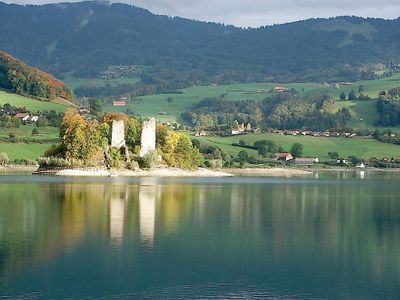
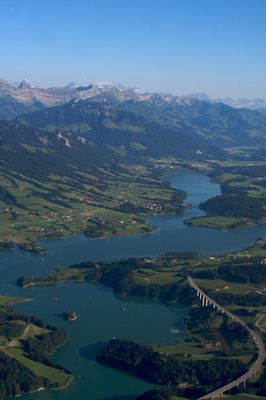
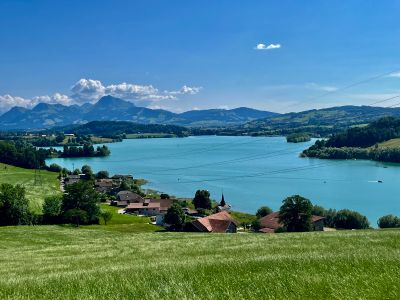
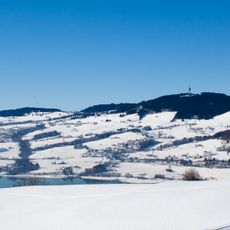
Lac de la Gruyère is a 13.5 km reservoir on the Sarine between Bulle and Fribourg, held back by the 83 m high Rossens arch dam. Its 10 km² surface fills a valley once crossed by a 1544 stone bridge, now submerged. Near the lower left shore lies the Île d'Ogoz with its stone chapel, and the A12 viaducts cross the water at Le Bry.
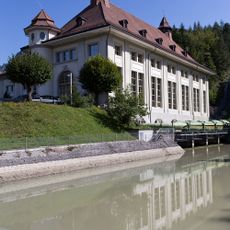
The cantonal council approved the Hauterive hydroelectric plant in 1943, and the Rossens arch dam was built under Henri Gicot by 1948. Up to a thousand workers were on site in 1946–1947, and costs reached 72 million Swiss francs. Filling began on 15 May 1948 and was completed on 20 September; the lake was inaugurated on 14 October 1948.
The lake takes its name from the surrounding region, where cheesemaking traditions have deep roots in the community. This heritage shapes how local people relate to the landscape and its resources today.
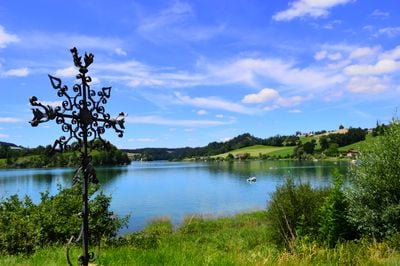
There is no scheduled boat service on the lake; small landing stages stand at several points and some shore spots are laid out as bathing beaches. The 50 km lakeside trail, opened in 2014, runs between 675 and 733 m and is split into three stages, each reachable by public transport. In winter the water is drawn down for power production, and after heavy flooding, as in July 2021, shore paths can be closed.
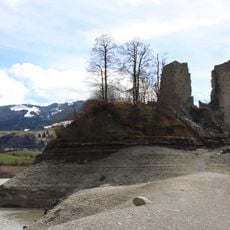
The Île d'Ogoz holds the ruins of two castles and a chapel that predate the Rossens dam. When the water level drops, a narrow strip of land emerges from the left bank and the island can be reached on foot, usually in spring; otherwise a floating landing stage serves boats.
The community of curious travelers
AroundUs brings together thousands of curated places, local tips, and hidden gems, enriched daily by 94,407 contributors worldwide.