Grüt, Residential district in Gossau, Switzerland
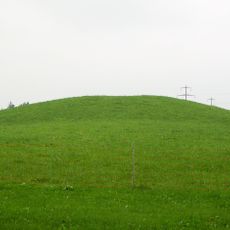
Grüt is a residential district in northeastern Gossau that spans gentle hills at elevations between 541 and 555 meters. The area forms a substantial part of the municipality with mixed housing types including single-family homes and smaller residential complexes.
Grüt first appears in documents in 1267, later than other parts of Gossau; its name comes from the Middle High German word for clearing land. Its inhabitants were tenant smallholders who paid tithes to the knight's house at neighbouring Bubikon. In 1440, during the Old Zurich War, Grüt was razed to the ground, the only part of Gossau to suffer this, and was rebuilt over the following fifty years.
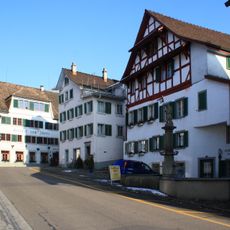
The name Grüt comes from the Middle High German word for clearing land, pointing to forest that was cut back for farming. The hamlet of Bönler, now part of Grüt, was founded by settlers from Unterwetzikon outside the village boundary on the common land. In the old core, several Flarze still stand, farmhouses with continuous ground-floor window fronts facing south to light the loom or spinning wheel of home weavers.
Grüt has no railway station of its own; buses of the Verkehrsbetriebe Zürichsee und Oberland run every quarter hour to Gossau and Wetzikon during main and off-peak times, and every half hour in the evening and on Sundays. The former Wetzikon–Meilen overland tramway no longer runs; road access is via the Wetzikon–Gossau and Wetzikon–Ottikon main road. A Volg with a post office (PLZ 8624) is in the village.
Grüt lies in the drumlin landscape of the Zürcher Oberland. The hamlet of Bönler, now part of Grüt, was founded by settlers from Unterwetzikon outside the village boundary on its common land; when it was joined to Grüt is not recorded.
The community of curious travelers
AroundUs brings together thousands of curated places, local tips, and hidden gems, enriched daily by 93,688 contributors worldwide.